


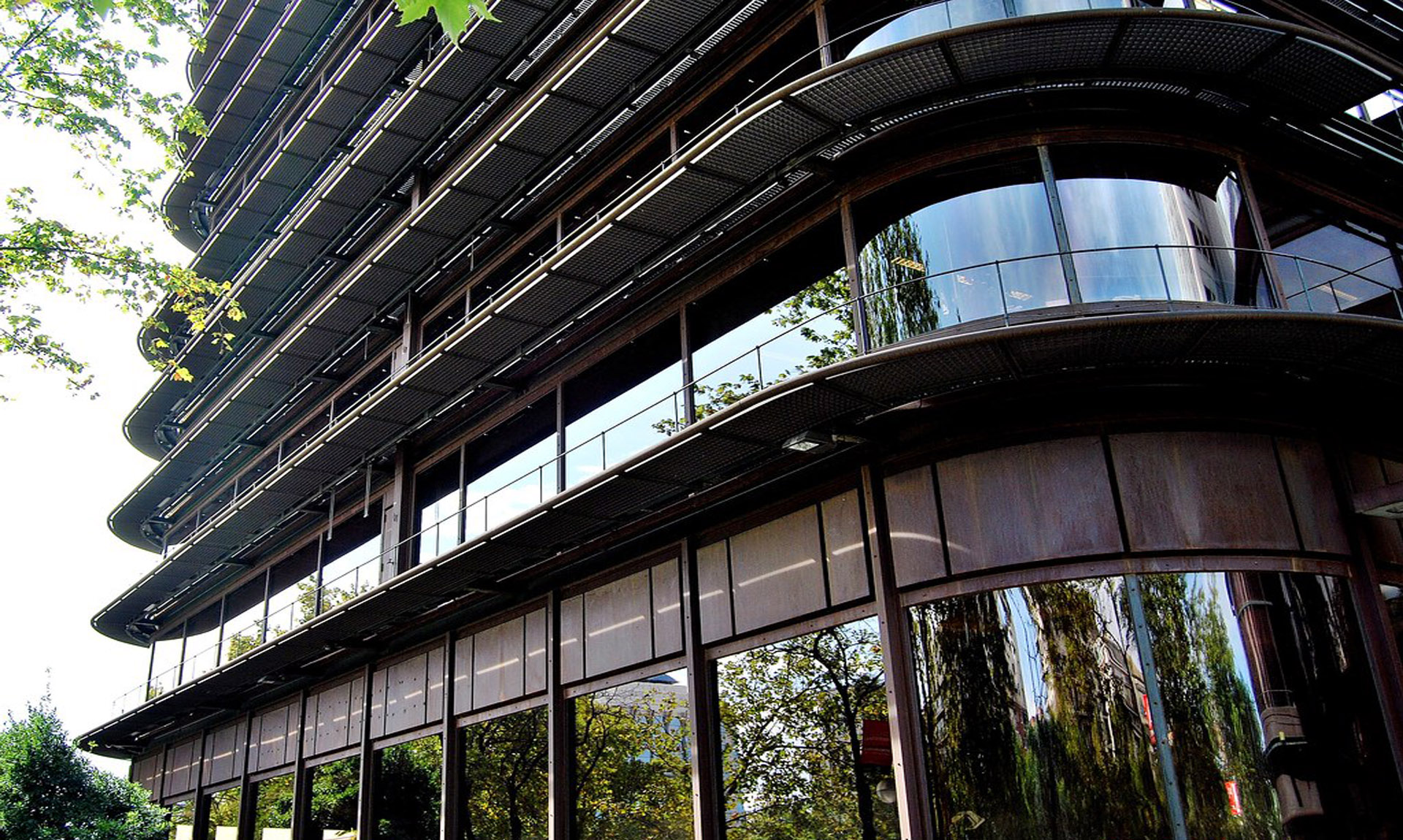
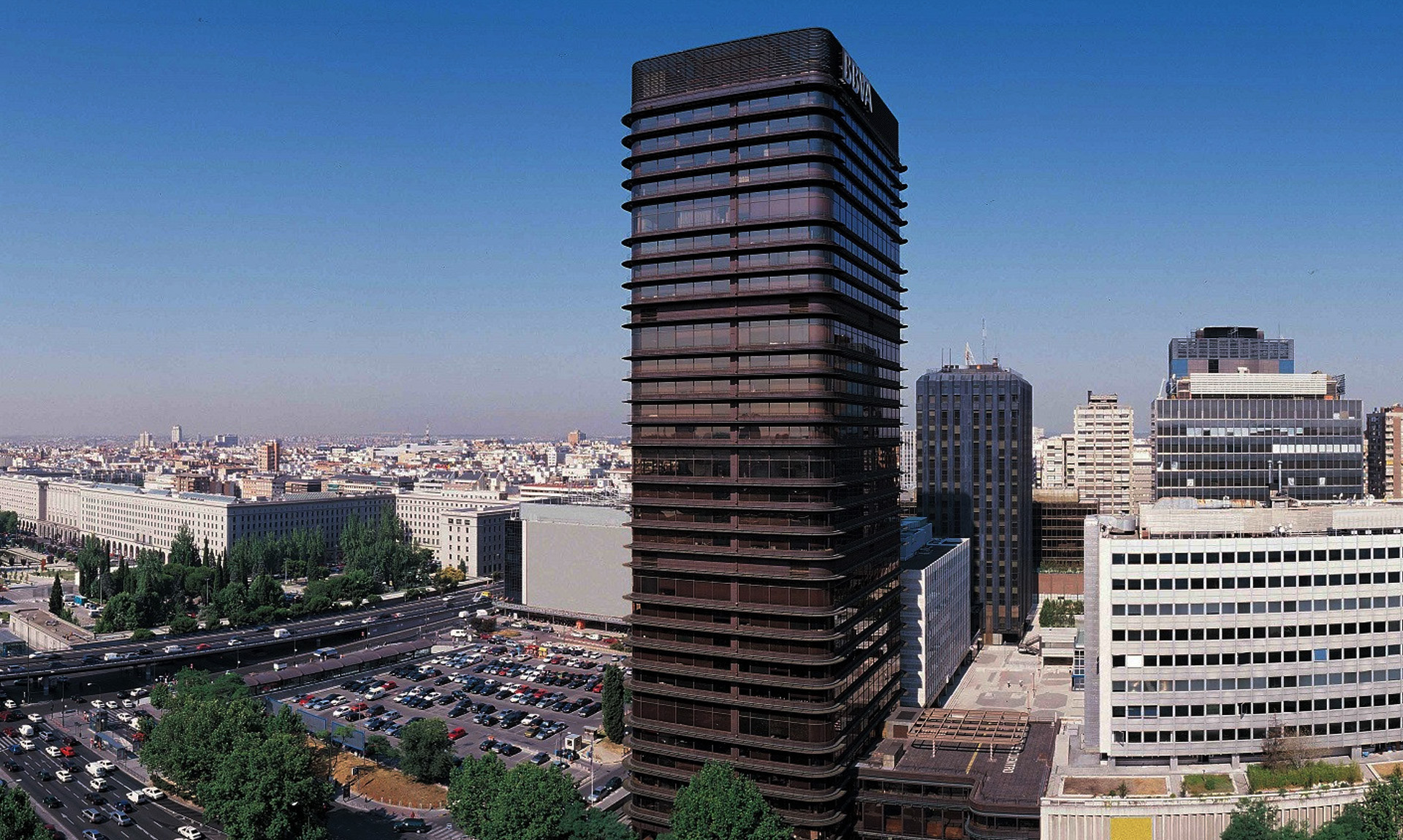
Bilbao Bank. Madrid. Spain.1976.
This building has 31 floors above ground level and four below ground level, where the facilities and warehouses are located. The main reason for the particularity of the building is the fact that it was built over the railway junction tunnel between the stations of Atocha and Chamartín. The consequence of this situation was that the main supports of the building had to be 19 m apart on the inside faces. It was particularly expensive to make the structure of each of the 30 m x 40 m floors with this span, so it was decided to concentrate the work of bridging the tunnels on 6 prestressed concrete platforms, each supporting five normal floors of light metal structure. The prestressed concrete platforms are supported by the two vertical communication cores, placed one on each side of the lower tunnel. The platforms are made of prestressed concrete and consist of two large prestressed longitudinal beams, which are attached to the vertical cores.
The platform is completed with 8 transverse beams, also post-tensioned, which are supported on the longitudinal beams to form a monolithic grid. The problem with this grid was its support on the cores. These are formed by a box section, through which the lifts slide, 10.56 m long and 6.3 m wide, with walls 0.85 m thick. The two large longitudinal beams of the grating are 2.01 m high, prestressed and have a double “T” section. The cross beams, also double “T” beams, vary in depth from 2.01 m to 1.41 m at the edge. All of this grillage was prestressed. The problem of the connection between the core and the platforms was caused by the creep and shrinkage deformations of the concrete of the platforms, which caused very significant stresses in the vertical cores, highly rigid cores embedded in the foundations.
To avoid this, it was first planned that these prestressed concrete platforms would be prefabricated and attached to the core by prestressing, but for the convenience of the construction company they were built “in situ”, so it was necessary to provide an external support which, by leaving the core, allowed longitudinal movements to take place without being constrained by the cores.