

Rehabilitation of the Segovia Aqueduct. Segovia. Spain. 1974.
CFC Scope
Rehabilitation project
Project Manager
Carlos Fernández Casado
Project Manager
Carlos Fernández Casado
Rehabilitation end date
1974
Typology
Rehabilitation
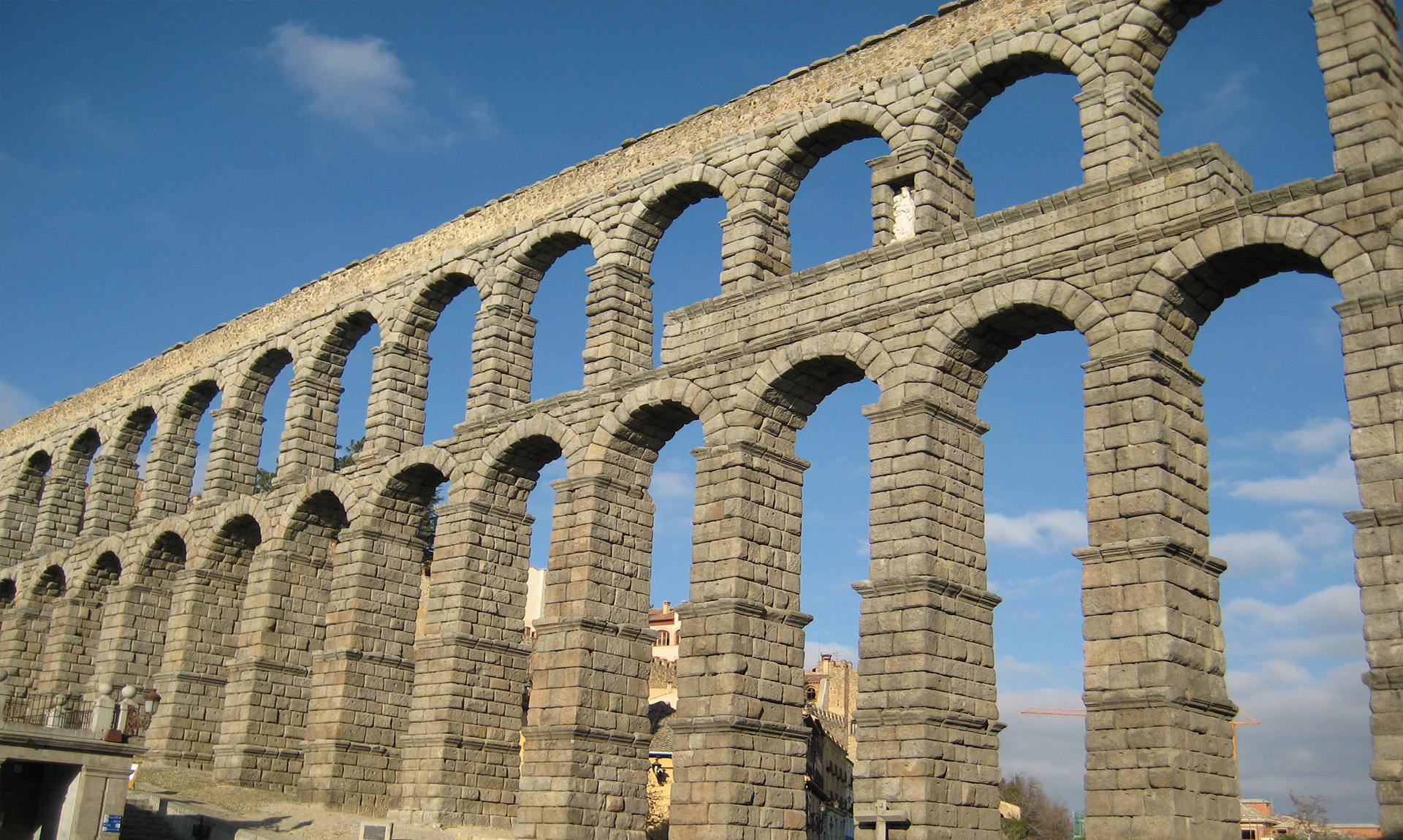
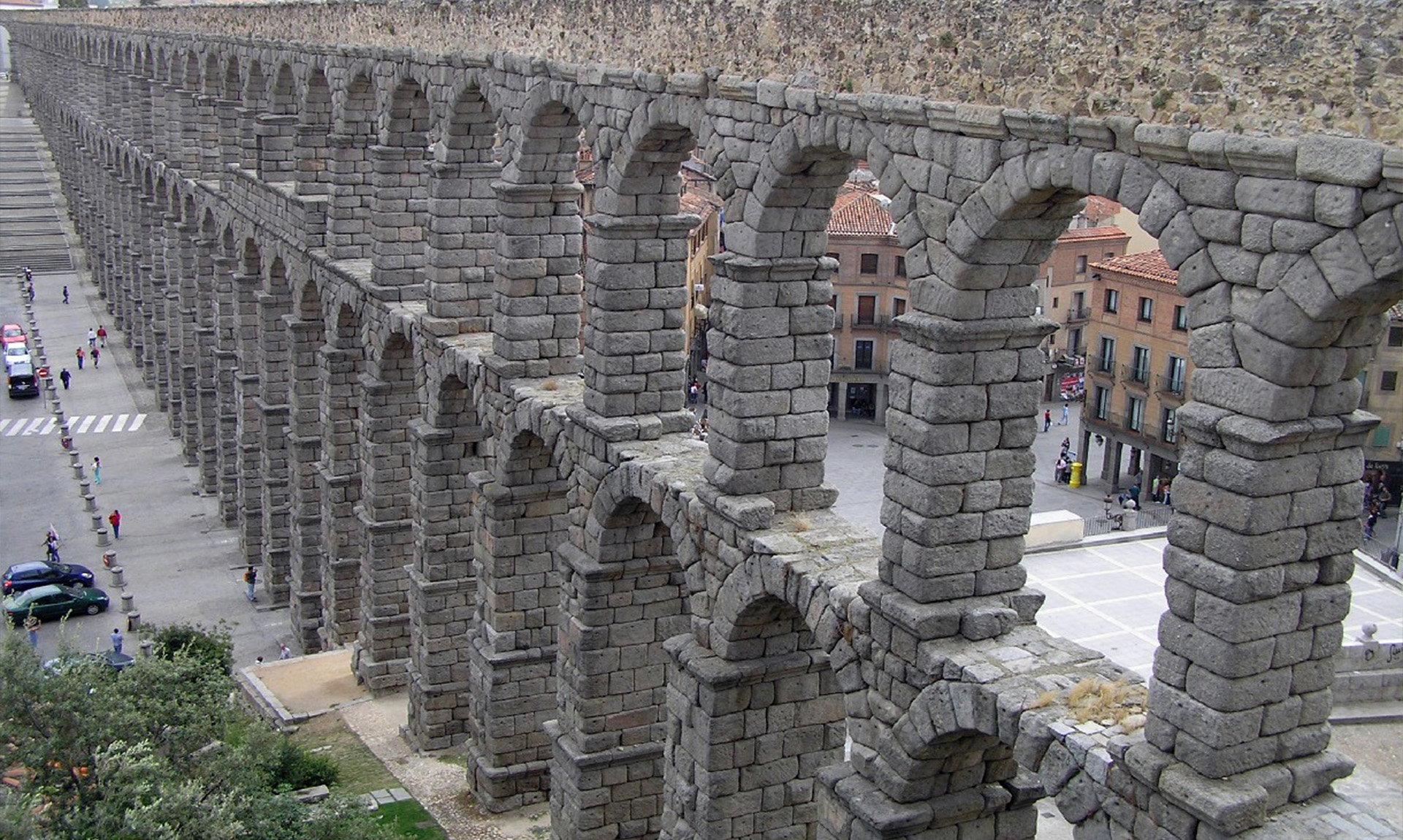
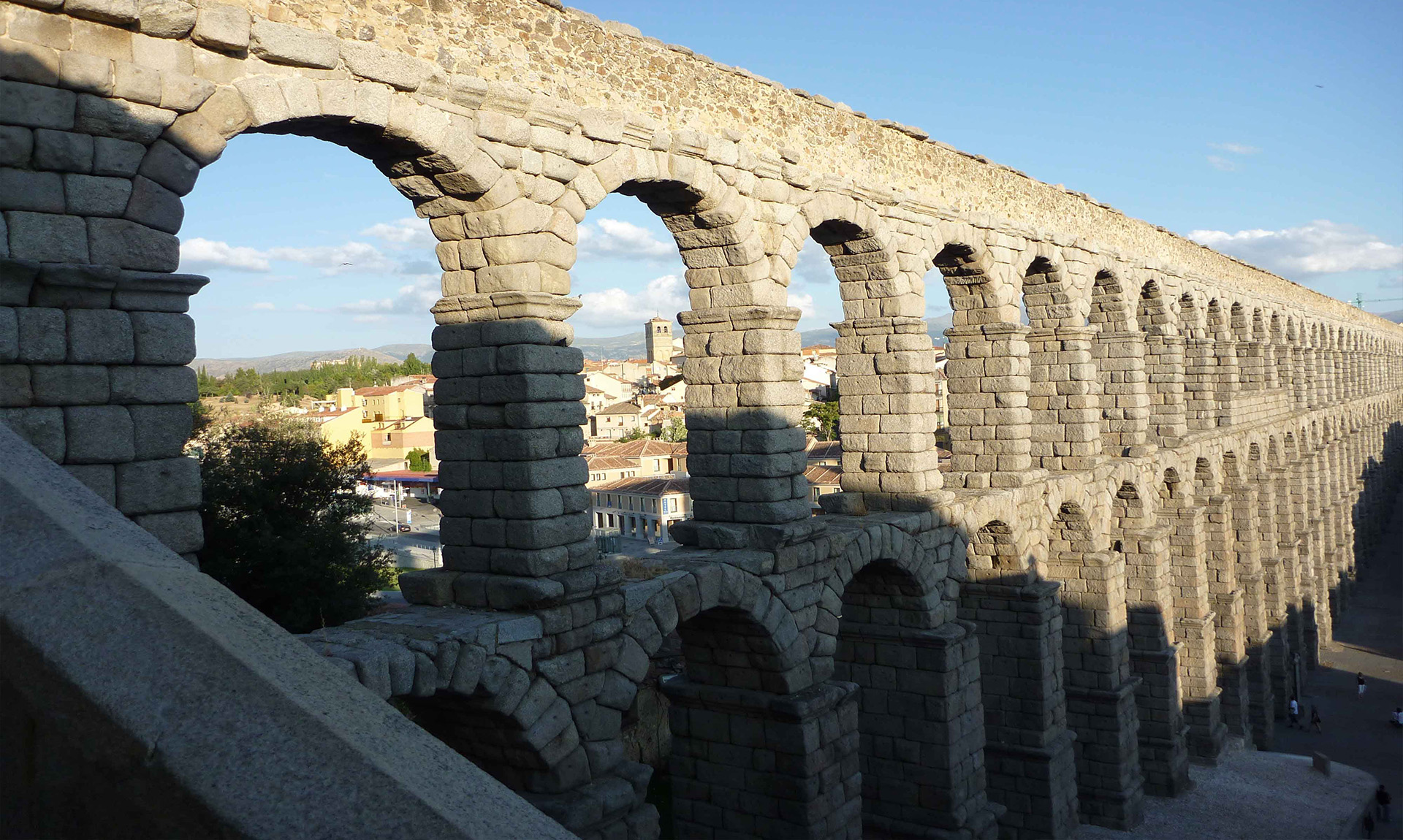
The Aqueduct of Segovia, in its most important and well known area, can be considered from the ontogenetic and phylogenetic points of view as a superposition of two arch bridges. The lower one, with pillars of variable height staggered according to the height, has a body very appropriate to its working conditions and is firmly founded on rock. Its arcades with spandrels with spandrels spandrels up to the level of the keystones, were crowned by a continuous course that appeared on both sides molded in cornice. In the course of nearly twenty centuries, this course has almost completely disappeared, as its ashlars were easily disassembled, except for those retained directly by the pillars of the superimposed bridge. This second bridge of constant height with equal arcades that cut out in the sky its silhouette of half point on square typical of the Roman aqueducts in Spain, has very slender pillars to be of factory without binder.
It is to this lintel that the survival of the monument is due, a lintel that serenades the appearance of the work and that has no functional justification, since the box (specum) cuts its insignificant section of 0.30 x 0.30 m in the plane of the top, centred between two rows of slabs with a deliberately irregular surface, pouring inwards and slightly protruding from the walls to outline a final cornice. There is a marked contrast between the two bridges: the lower one, well founded and poorly crowned, as opposed to the other, over-crowned and resting on the spandrels of the lower one, which are the most defective areas of the entire masonry. This defect is congenital to both bridges, a consequence of the lack of binder in their masonry, which is evident when we suppose that we were to pull out any arch voussoir, and even better one that is perpendicular. The fatal consequence would be the ruin of the whole work, as the hollow of that voussoir would start a crumbling of the successive ones of the same arch, which would spread without stopping to the ashlars of the tympanum contained by them; the pillars of the crumbled arch would collapse due to an imbalance of thrusts dragging the two adjacent arches, which would collapse without remission, and so on and so forth.
The celebrated attic could replace the arch it shelters in each section, if there were two effective pillars reaching up to it, extending the existing ones through the tympanums to form a portico with the attic, a portico that would take up the corresponding weights, with the arch remaining as a simple support. The same thing would happen in the lower arcades, where the arches are deliberately intended as shoring, if there were effective vertical elements to directly join the existing pillars, but instead of these we have piles of ashlars contained by the arches that they span. This aspiration to achieve true pillars over the entire height will be the goal in the evolution of Roman aqueducts, the achievement of the Los Milagros aqueduct in Mérida being exemplary. The guiding idea in the evolution of the type we have just described has given us the fundamental guideline for our project and, following it, we have tried to achieve vertical trajectories of forces from attic to foundations, linking the two existing pillars with each other and with the crowning lintel through the tympanums, avoiding herniated trajectories inside the tympanums. This has been achieved by reconstituting part of the masonry by means of cement injections to ossify vertical spines within the amorphous zones of loose ashlars.
This vertebration has been carried out as far as necessary, in order to change the longitudinal stiffness of the structure as little as possible, as it must not be forgotten that temperature changes cause considerable deformations in the alignment of arches over 250 metres long. Accordingly, the cement mortar injections have been located in the spandrel areas around the vertical axes of the supports, pouring the fluid mortar through perforations made from the box for the upper spandrels and from the pillar supports for the lower ones. As the cement grout penetrates, it spreads, occupying trapezoidal areas with a strict dimension in the pouring area, widening to penetrate the arch starts, which also results in effective symmetrical spandrels that reduce the span and prevent the starting segments from falling. Overall, we have succeeded in moving from the instability of a house of cards with a succession of superimposed arches made of masonry without binders, to the satisfactory serenity of a structure with a rectangular grid of beams and pillars. This fundamental objective has been completed with other local attentions which are as follows:
-The underpinning of the foundation of a pillar, exception to the rule of firmness that we had pointed out, where because of the transformation of the soil by human work and complementary erosion the support base had been left flush with the ground. It is made with a strapping frame and pillars of small diameter starting from the same. -Repair of perpendicular ashlars and voussoirs, broken in the natural adjustment of the adaptation movements between masonry and foundations, and between the immediate ashlars whose seating surfaces were not properly prepared for direct contact without intermediate mortar. They have been stitched by means of metal bars inserted in previous perforations, which are filled with epoxy-based injections, which also penetrate the ashlar failure,
-In the project, the initial objective of consolidation, that is, to restore and even improve, as we have seen, the initial resistant qualities of the structure, was combined with another of an aesthetic nature: to restore the artistic integrity of the monument, dismantling what was barbarously added and reintegrating, as far as possible, what was also barbarously taken away. Thus, the resistant conditions have been restored and even improved with the injections, without affecting the appearance of the masonry, and the much-needed consolidation has gone unnoticed (the reinforcement of the foundation is not visible either). On the other hand, by removing the added walls, we have improved the conservation conditions of the monument by leaving the canal free, which has been waterproofed with a treatment of the joints based on flexible epoxy mortar, and we have re-established the hydraulic conditions of the Aqueduct, which will be able to continue transporting water (“in perfecta equalitate” as Vitruvius would say). Finally, although only in part, we have re-established the silhouette that the Romans gave to our Aqueduct, since the crowning line vibrates in its original line in unison with all the verticals that were deliberately left without straightness. But the other horizontal line, the crowning line of the lower floor, has only been restored to its original shape in the four central arcades.