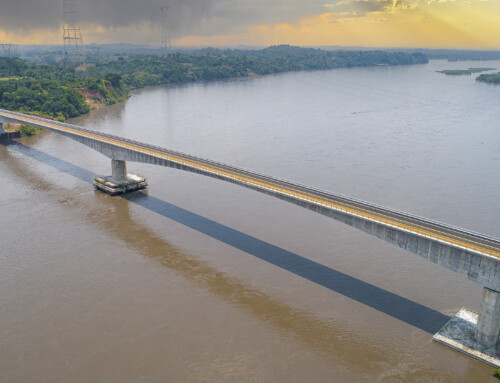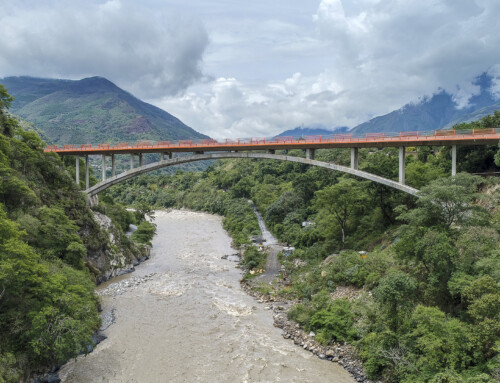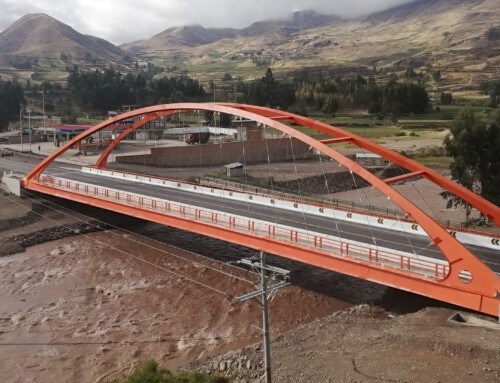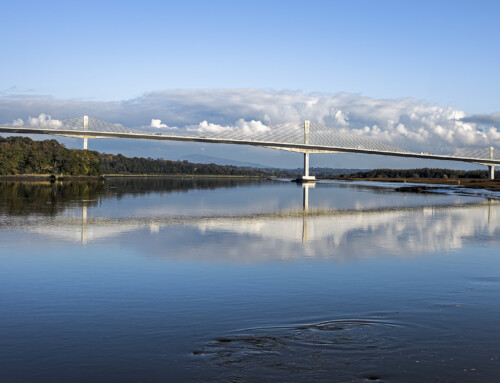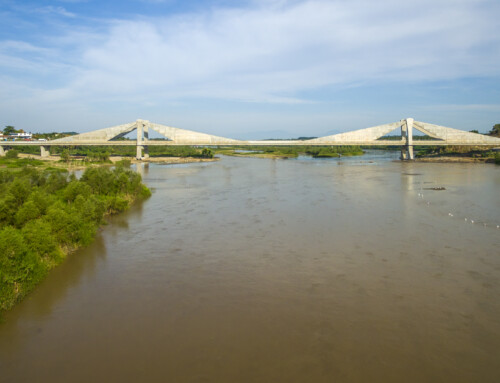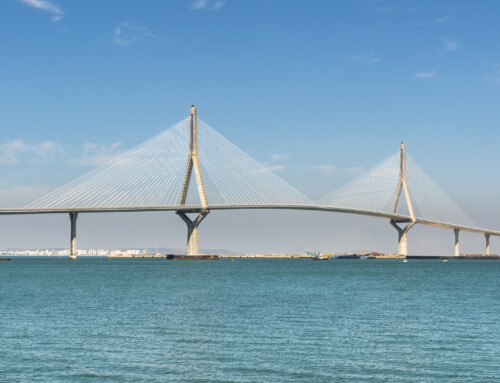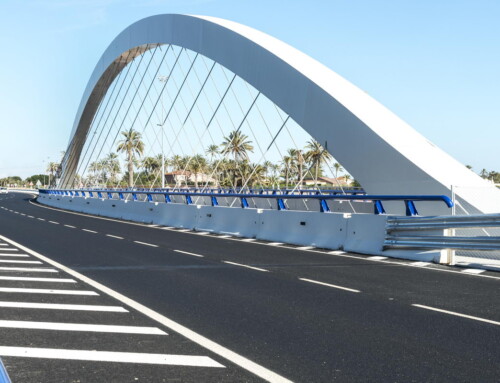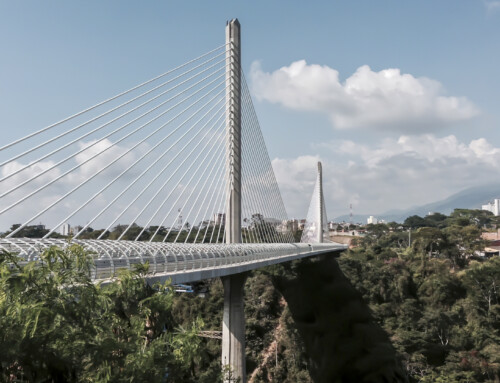


Bridge over the river Besaya. Cantabria. Cantabria. Spain. 2009.
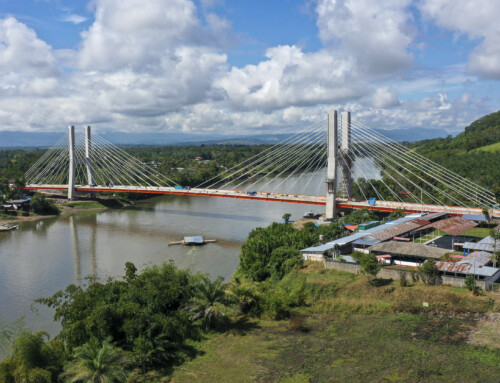
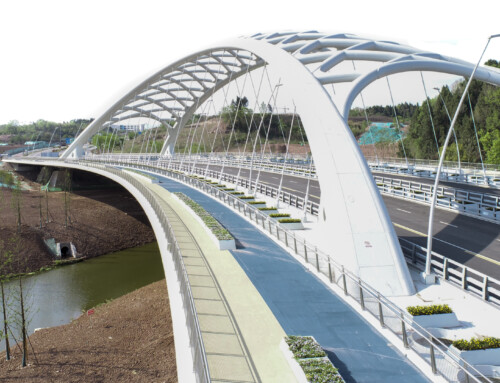
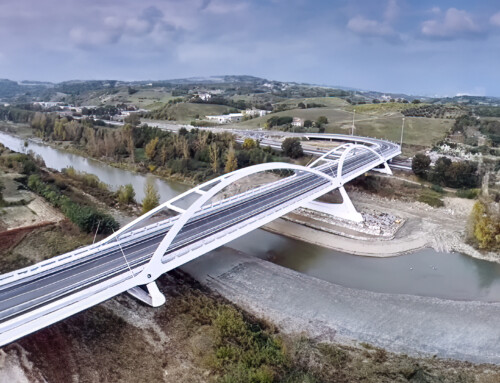
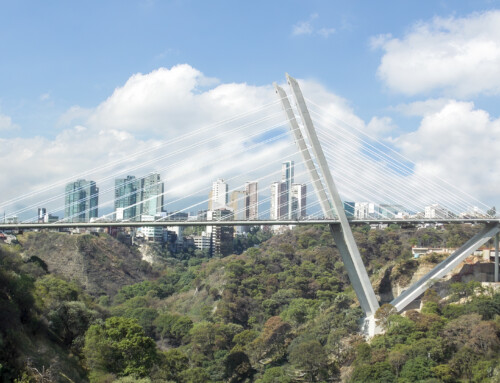
The bridge over the Besaya River is located on the CA-170 road in Cantabria in its section from Los Corrales de Buelna to Puente Viesgo. It has a single cable-stayed span of 134,60 m. This configuration was determined by the projected channeling of the river, which did not allow the placement of piers in it. The span was determined by the width of the channeling, the riverside paths and the obliquity of the route over the river.
Subsequent to the drafting of the project and the awarding of the works, the idea of channeling the river was abandoned, maintaining the existing river bed unaltered, with a main channel of the Besaya River that is bridged by the project bridge, and a side channel of the Barcenal stream that flows into the Besaya River, which is bridged by a 154 m long access viaduct.
In the separation between the Besaya River and the Barcenal stream is located the abutment of the cable-stayed bridge that is inscribed in a circular island.
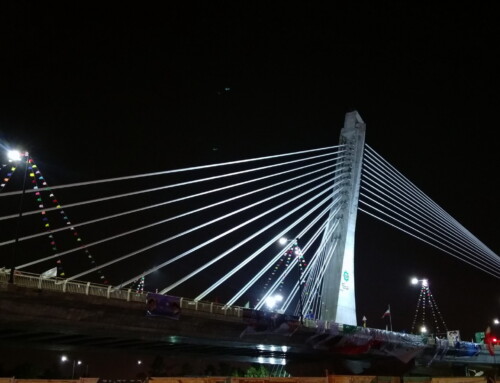
The main bridge is a single span cable-stayed bridge without offsets. It has been designed as a symmetrical bridge with two cable-stayed towers, one on each bank, each with two inclined piers. The compensation stays are anchored in the counterweights, attached to the towers forming a single element, independent of the deck. Therefore, there is no balance of horizontal forces in the deck between the front and compensation suspenders. This balance is achieved by means of a variable traction in the deck, which is resisted by active reinforcement. The horizontal loads of the rear suspenders must be transmitted to the ground.
The towers, inclined towards the outside of the bridge, have a height of 30.5 m above the deck. The nine fan-shaped front stays are anchored to them. For each front brace there are two rear suspenders, in symmetrical planes to the front. The rear suspenders are parallel to each other and are anchored to the counterweight.
The bridge was built by successive cantilevers concreted in-situ, using a travelling carriage.
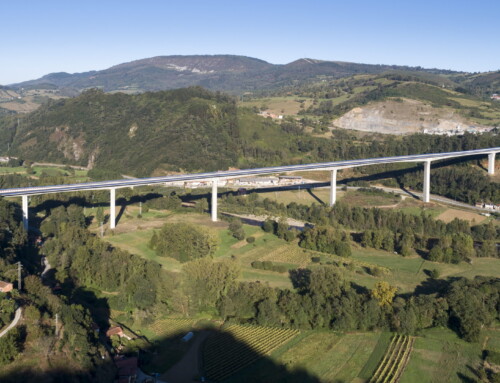
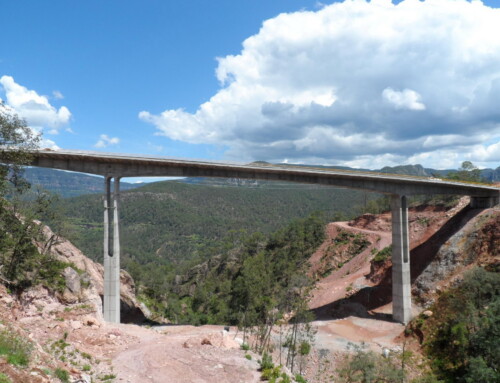
The access viaduct, made of prestressed concrete, has four spans of 32+45+45+45+32, and is supported at one end on the abutment of the bridge over the Besaya River, and at the other end on a new abutment. It has 3 V-shaped piers, which reduce the deck spans to 25+14+31+14+14+31+14+14+25.