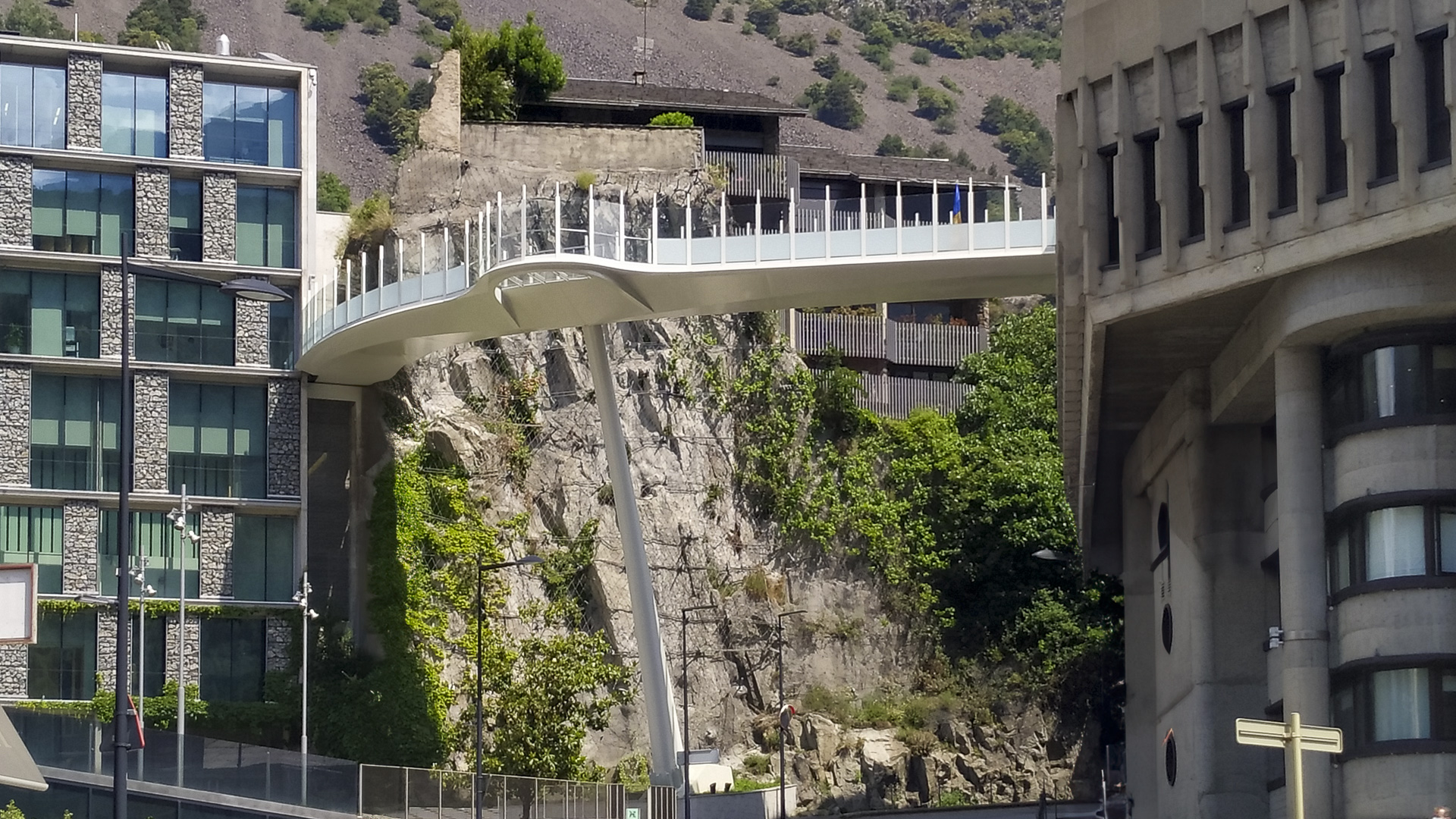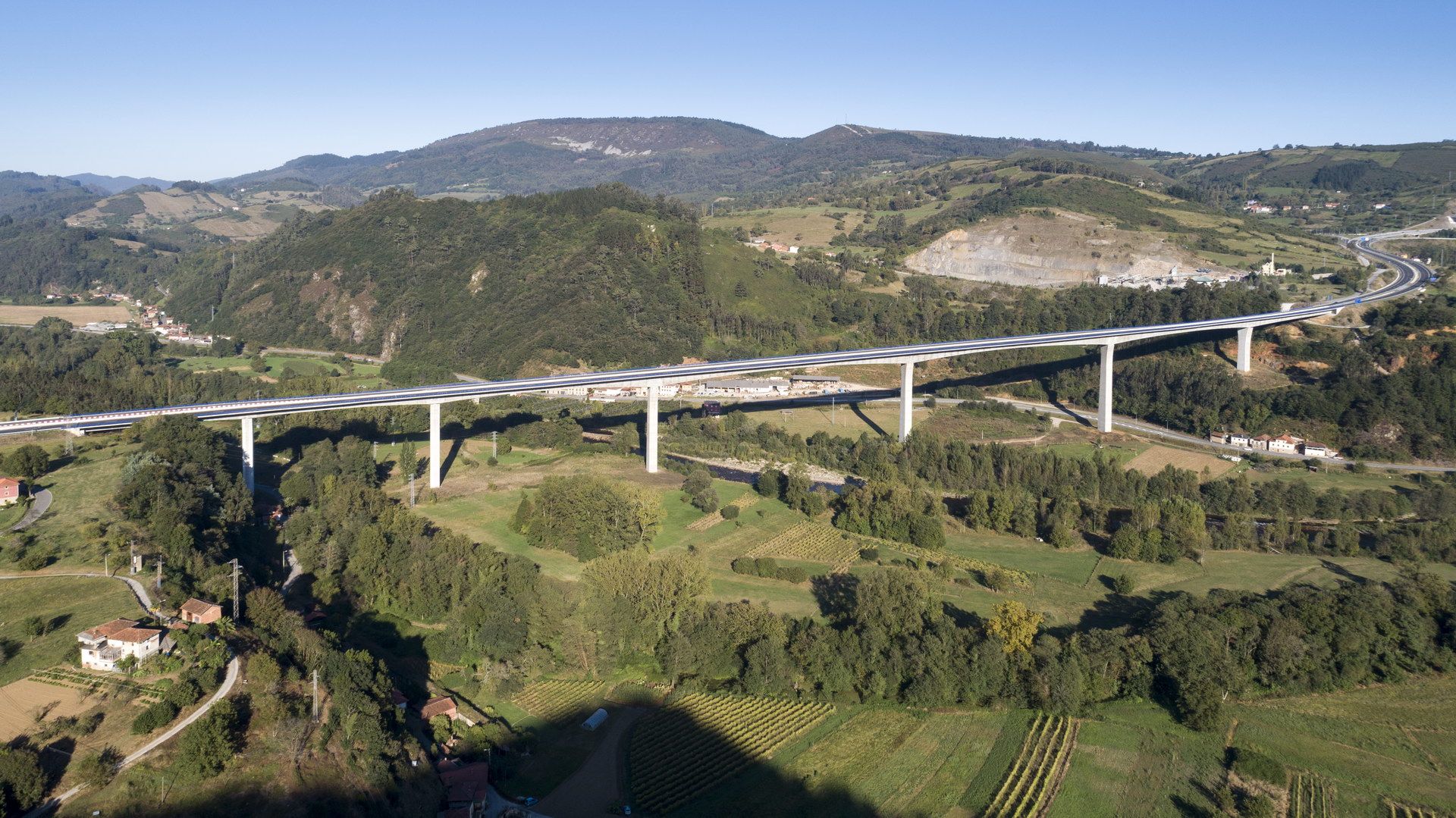


Centenary Bridge. Montserrat. Barcelona. Spain. 2003.
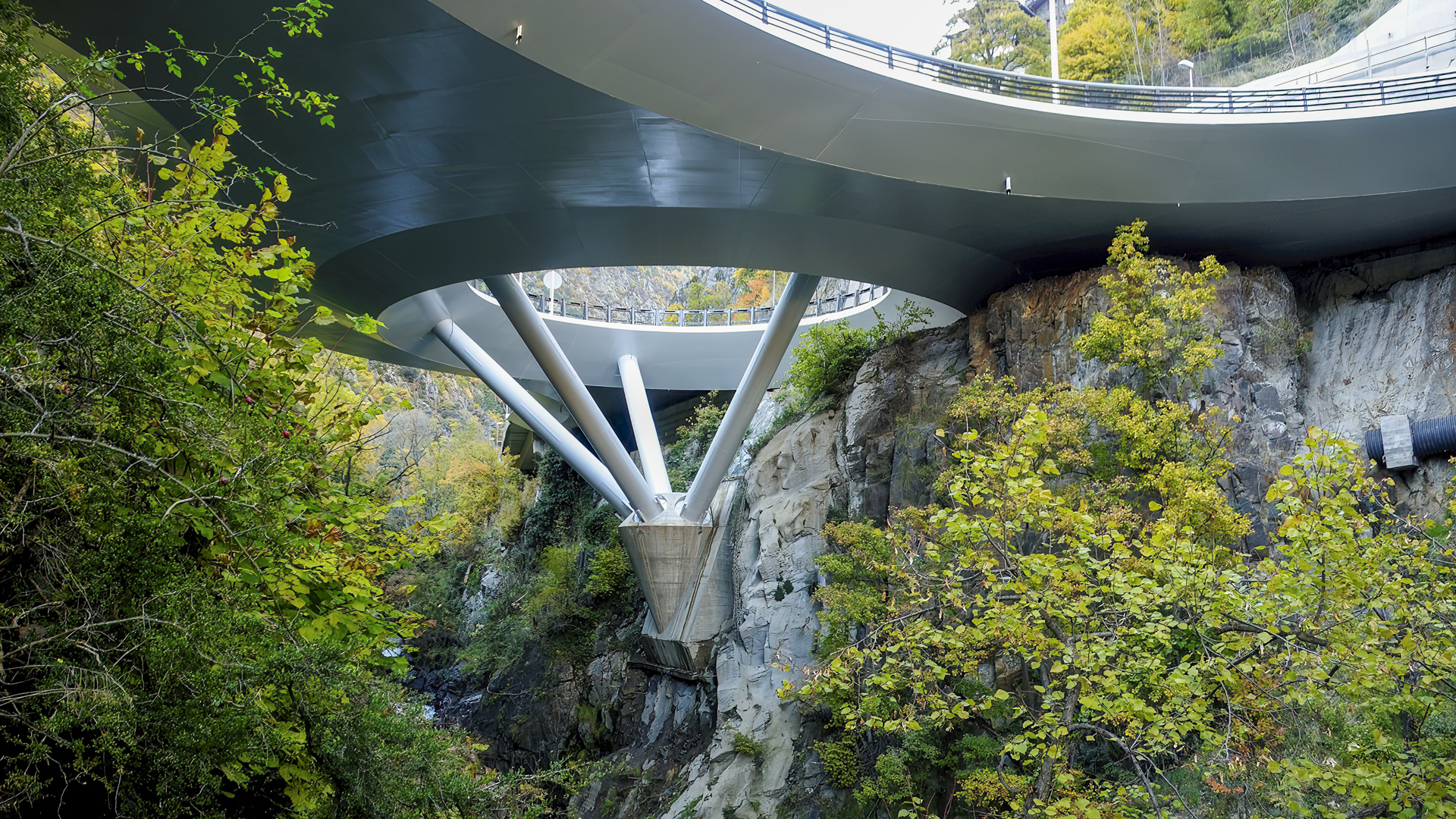
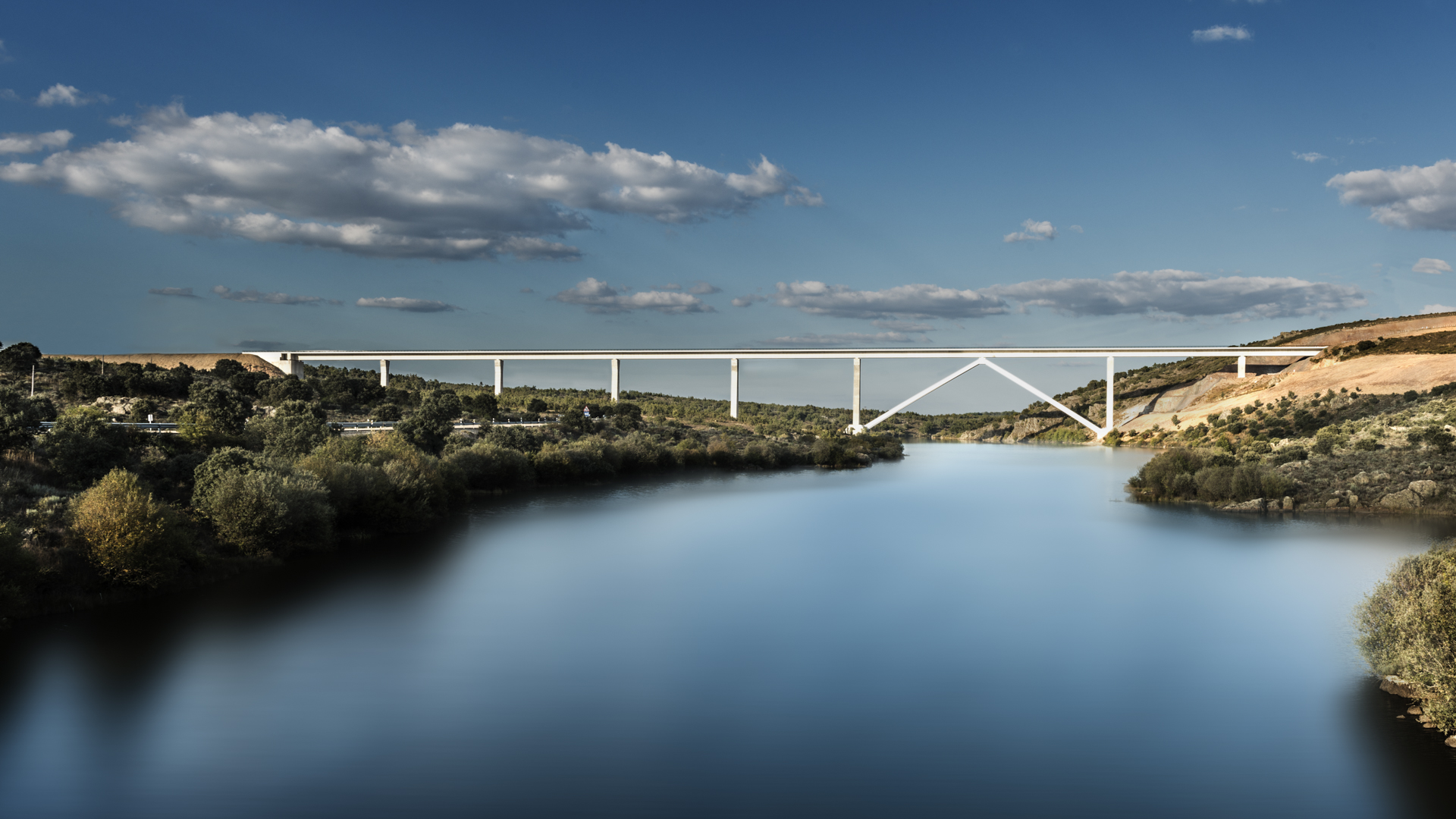
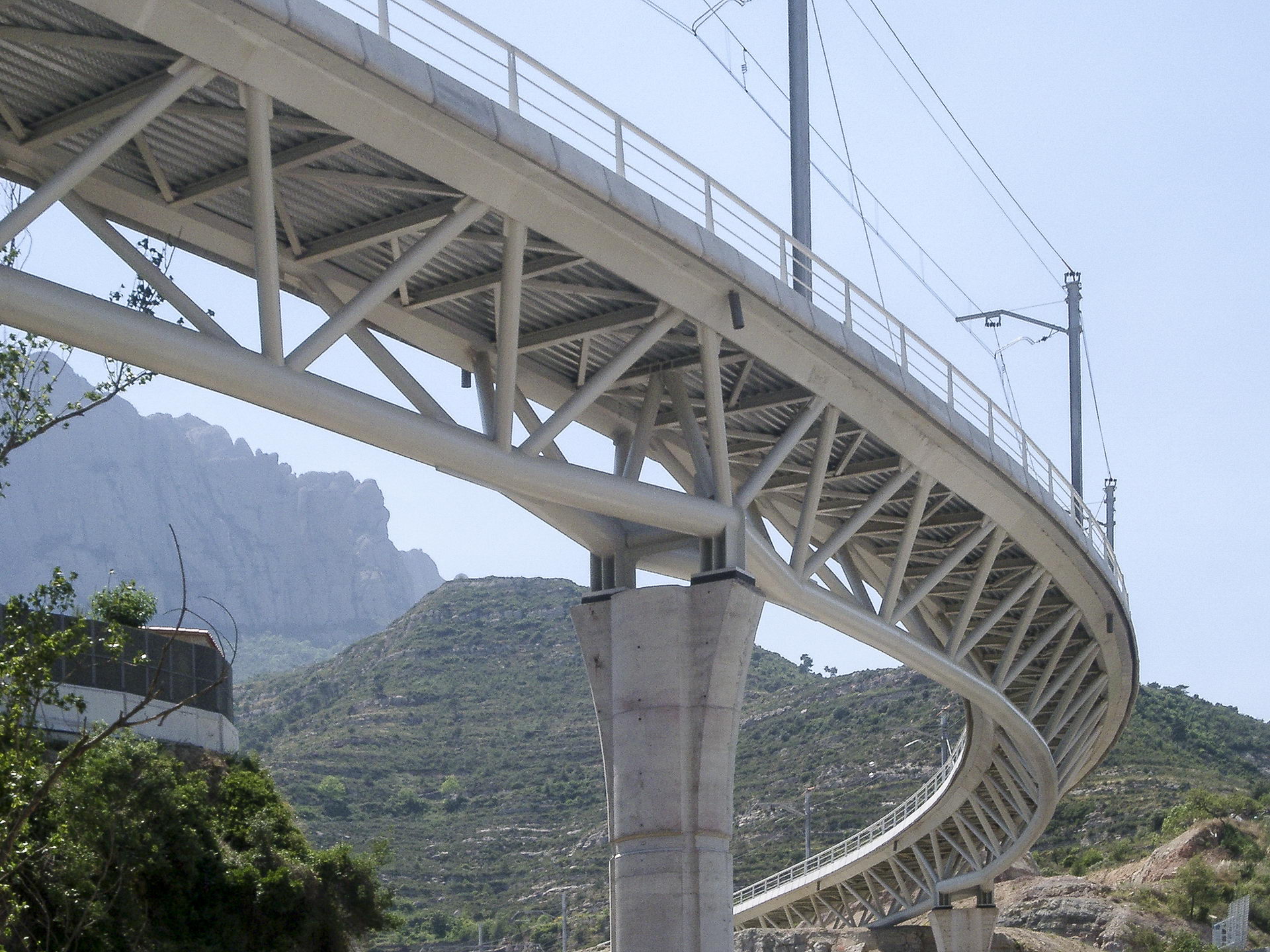
It has9 spans of 45+ 6×55 + 70 + 20m. The deck has a triangular section with a width of 5 m at the top and a 3 m edge. From a resistance point of view, the lintel is constant and consists of three longitudinal metal chords, a 600 mm diameter lower tube and two metal trapeziums at the top that connect with the upper reinforced concrete slab, both in the negative and positive moment zones. The triangulation of the webs is carried out with 270 mm diameter tubes.
A problem with any triangular lintel is the support on the pile, with the necessary transverse dimension to stabilise the lintel against overturning. Other solutions have the lintel at the top, where there are two chords. We abandon this arrangement and resort to opening the lower chord of 600 to reach the minimum 2.00 m spacing. The triangulation of the web is perfectly suited to this change.
In a previous study we tried a transverse embedding of the lintel in the pier by means of tie rods, but this proved to be too flexible if we wanted to keep the tie rods within acceptable dimensions.
In the initial design there was no 70 m span, so the lintel was designed for the 55 m span. When, due to special difficulties in the foundations of a pile, it was necessary to create a 70 m span, the problem was how to adapt the lintel to the new span, which was also the extreme span. The solution consisted of reinforcing the tubes with circular metal caps, perfectly coupled to the base tubes and also creating a 20 m concrete span behind the abutment, embedded in the previous one, which made it possible to adapt the deflections to admissible values and reduce the amount of stresses, going from an embedded – supported beam to a bi-recessed beam. In addition, this area is curved.
Our design intention for the bridge was to maximise the slenderness of the piers, to ensure that the support of the bridge was almost punctual, avoiding a shaft with a large transversal dimension to face the wind. We resorted to a 2.00 m diameter shaft to which we introduced four vertical grooves. These grooves facilitate the transition from the circle to a small 3.38 m wide capital capable of accommodating the two lower tubes of the lintel’s lower chord. At the bottom, we did the same thing again to increase wind resistance in 40 m high piers.