

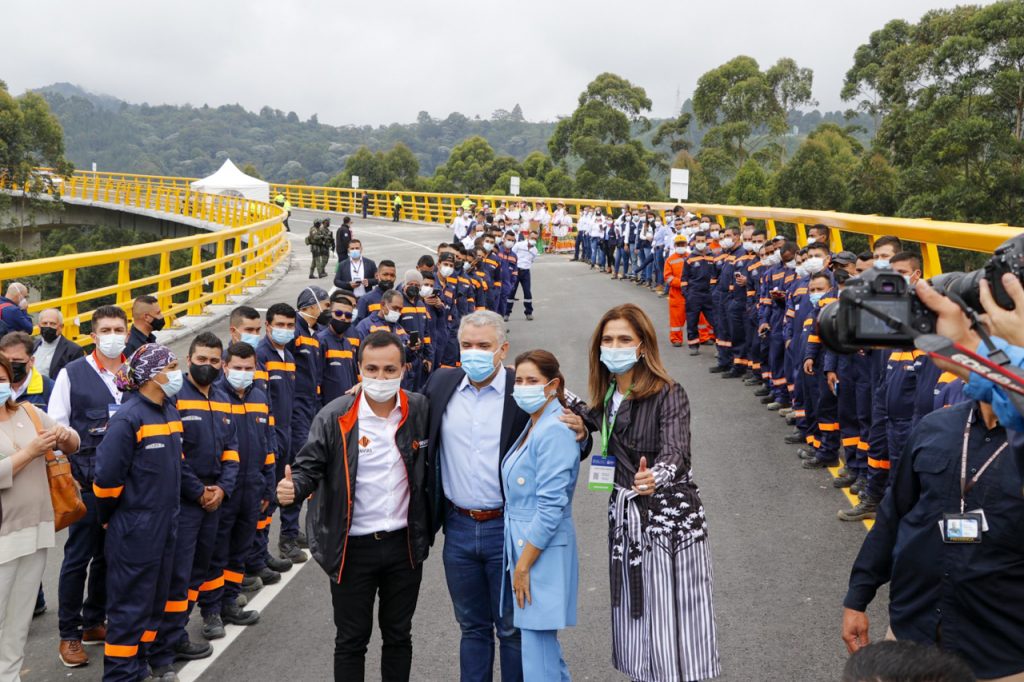
Iván Duque Márquez, President of Colombia, inaugurates the Yarumo Blanco viaduct in the Cordillera Central.
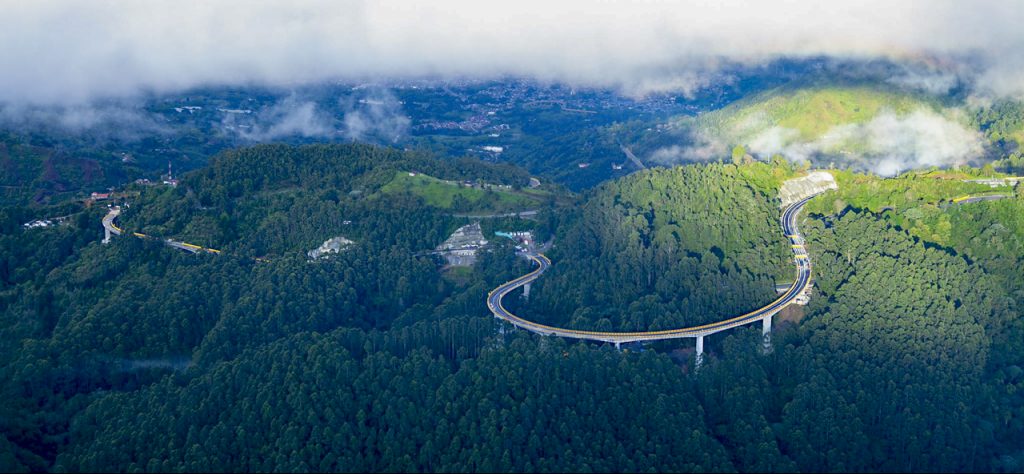
Last Monday, one of Colombia’s most important infrastructure projects was inaugurated.
Juan Esteban Gil Chavarría, director of the National Roads Institute; Invías, the President of the Republic, Iván Duque Márquez; the First Lady of the Nation, María Juliana Ruiz Sandoval; and the Minister of Transportation, Ángela María Orozco Gómez, officially inaugurated all the works that comprise the Central Cordillera Crossing.
The “Cruce de la Cordillera Central” project is a series of infrastructure works that will facilitate the road connection between Bogotá and the Pacific Ocean in the town of Buenaventura, in the state of Valle del Cauca. It forms the left arm of National Route 40, which divides Colombia from north to south, and will reduce the time it takes to travel through the Cordillera Central.
It consists of 60 works: a main tunnel called Túnel de la Línea of 8.6 km, 25 tunnels of different lengths, 31 viaducts, 3 interchanges and 30 km of road paving.
It was conceived in 1902 to originally connect Bogotá with the west coast by means of a railroad line, hence the name “tunnel of the line” which was given to the top of a mountain Alto de La Línea at 3250 meters above sea level.
Work on the project began more than ten years ago, but due to various unfortunate circumstances it had to be halted – as were the other road works of which it was a part – and the viaduct was only partially built.
INVIAS of the Ministry of Public Works, the agency responsible for the country’s road network, responded to this need by relaunching the works as soon as it had the opportunity.
The work was rescheduled to be delivered in two phases: the first was on September 4, 2020, which consists of a main tunnel of 8.6 km, 3 short tunnels of different lengths, 5 bridges and 13 km of dual carriageway, works inaugurated by the President of Colombia Iván Duque.
The second phase of the project was inaugurated on Monday, November 22, 2021, which consists of 20 short tunnels, 26 bridges and about 17 kilometers of dual carriageway, where the Yarumo Blanco bridge stands out, a very complex bridge, in which we put all our energy.
These infrastructures will make it possible to go from a road speed of 15 km/h to 60 km/h, reducing travel times for those traveling in light and heavy vehicles between Calarcá and Cajamarca by between 30 and 50 minutes.
According to Invías and the Ministry of Transportation, “this promises greater competitiveness for the country, a boost to the economy and tourism, since it connects the southwest of Colombia -which includes the port of Buenaventura- with the center of the country, where the main production centers are located”.
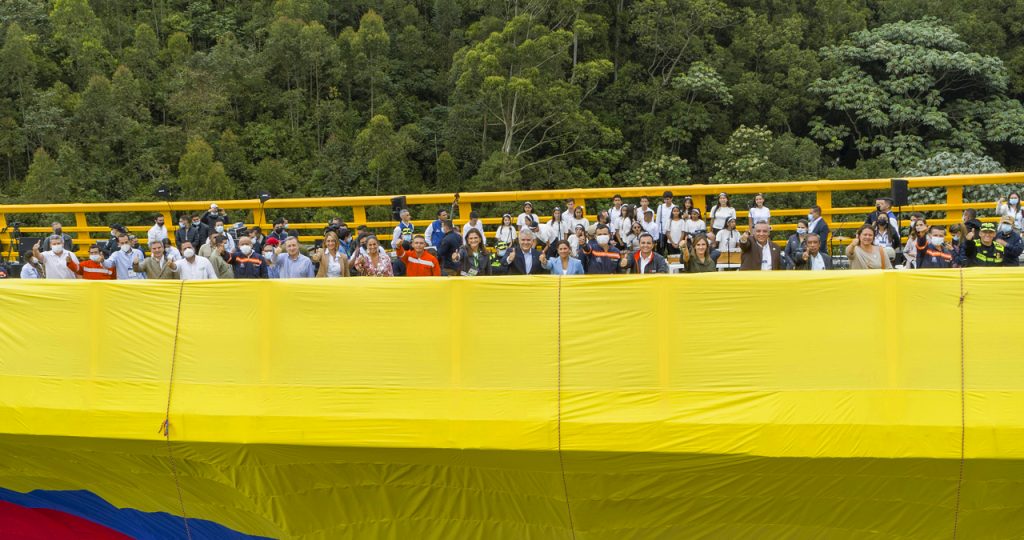
Yarumo Blanco Bridge
After a first phase in which the works were undertaken by another contractor, the tender for the final project to complete the works – called “Completion of the short tunnels, the open road and the bridges in the sector between km 7+895 and the Americas Interchange – Second Quindio Roadway – Central Cordillera Crossing Project” – was awarded to the proposal made by the Vias America Consortium formed by the OHL and Alca groups.
This consortium in turn entrusted CFC Sucursal Colombia with the Technical Assistance services for the works of the most singular structure of the project, the aforementioned Viaducto de la Herradura (Yarumo Blanco).
The total length of the structure is 640 m, divided by a joint in axis 6 into two sections of 300 m (axes 1 to 6) and 340 m (axes 6 to 12). The first structure (shafts 1 to 6) consists of five spans (37.5m-3×75 m-37.5 m) and the second structure (shafts 6 to 12) consists of six spans (34m-3×68 m-34 m).
The deck is a longitudinally prestressed concrete box section built by cantilevered advancement. It has a width of 11.30 m, and a variable depth between 2.00 m at the keystone and 4.20 m on piles with vertical cores.
The work was partially completed. Superstructure and substructure in full form between shafts 6 and 12, and only the substructure as well as some sections of the deck between shafts 1 and 6. The foundations were built on “caissons” (shafts) of varying depths, many of them built halfway up the slope in areas of steep slopes. The pillars were made of reinforced concrete with a rectangular section of variable dimensions with the height.
This is a highly complex project, set in a very curved, horseshoe-shaped layout with a 5% slope, with foundations located at mid-slope and abrupt variations in the geotechnical conditions.
Silvia Fuente, CFC’s project manager, tells us “It has been a real challenge to work on the reinforcement of a very complicated structure, to complete and adapt the bridge, already largely built, to the appropriate seismic standards.”