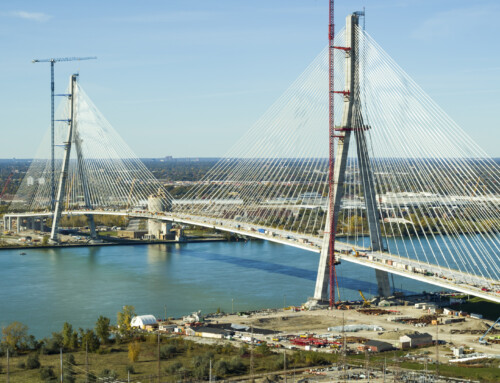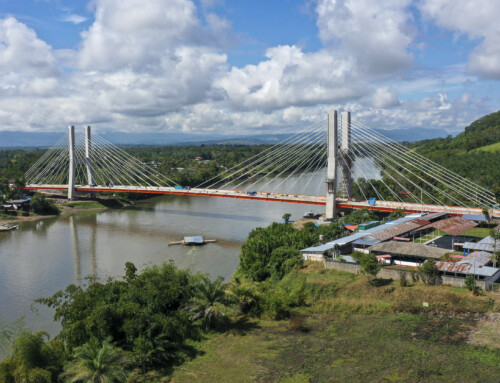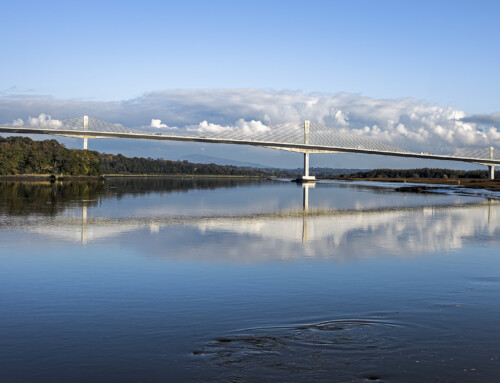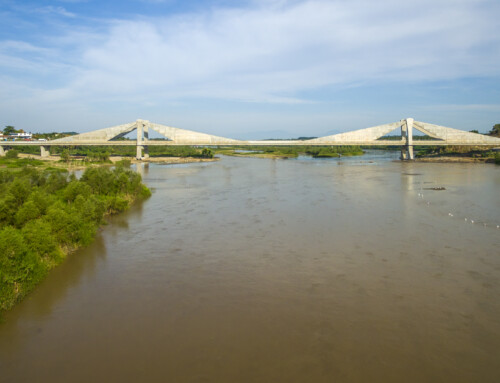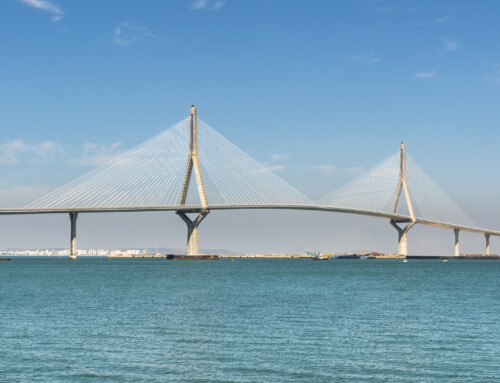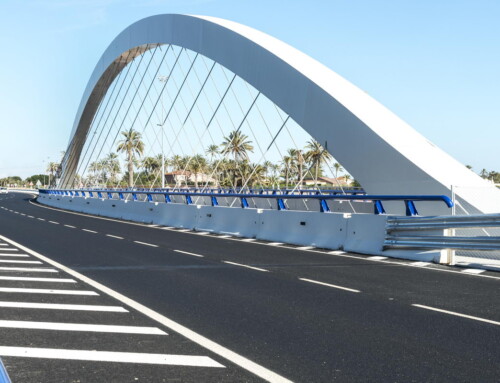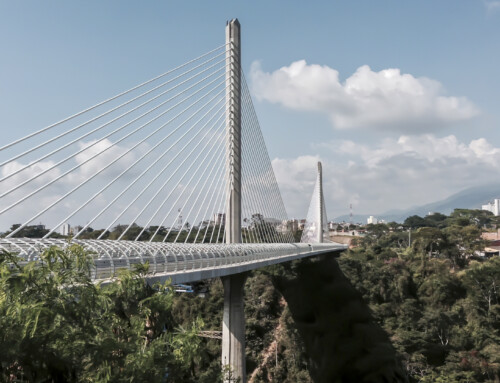


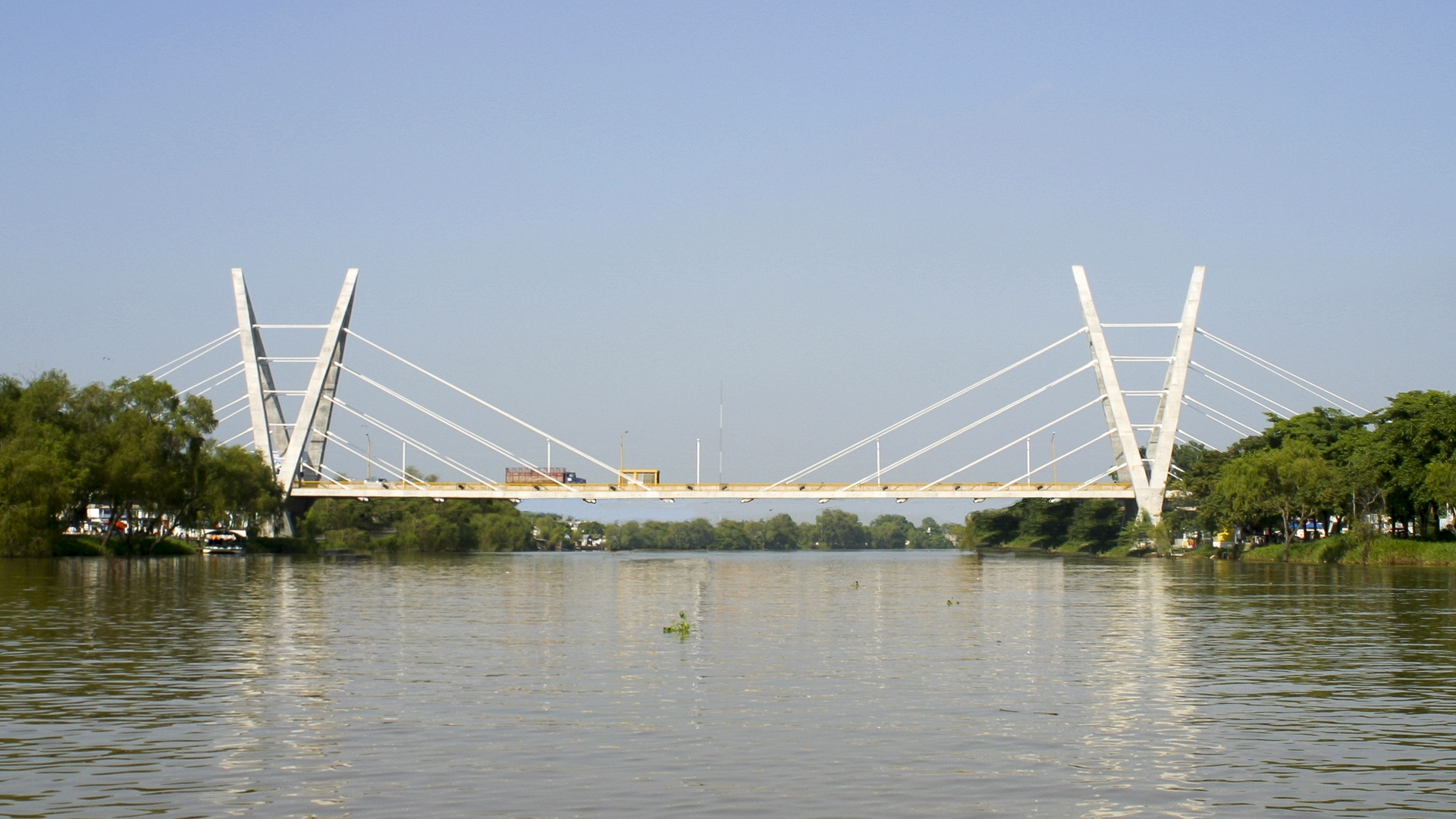
Grijalva Bridge. Villahermosa. Tabasco. México. 2001.
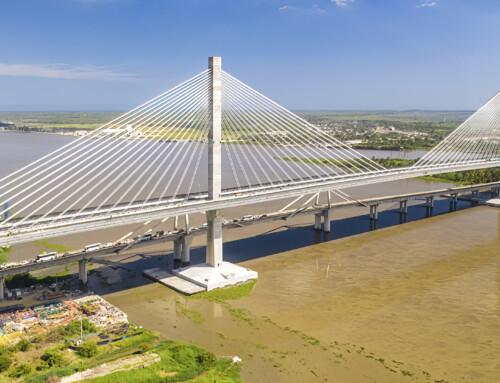
This bridge is the widening of an existing one, an old drawbridge with large piers in the river, which no longer opens, and which will probably be replaced in the future by one equal to the widening we have built. For these reasons, no homogeneous relationship has been proposed between the new bridge and the old one; on the contrary, a contrasting solution has been sought.
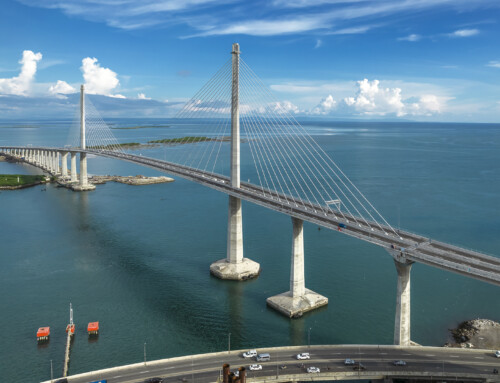
The new bridge spans the river with a single span of 116 meters. The width of the bridge is 10.80 m, and this makes it possible to give the deck a reduced edge, 0.80 m, because in bridges of this magnitude, the deck edge is more conditioned by the width of the bridge than by its longitudinal span.
The deck is formed, as in the Papaloapan bridge, by two longitudinal beams joined by diaphragms and by the upper slab.
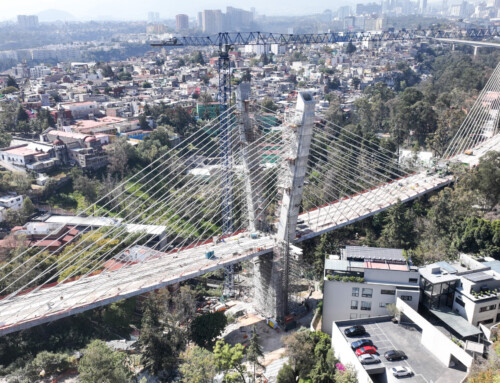
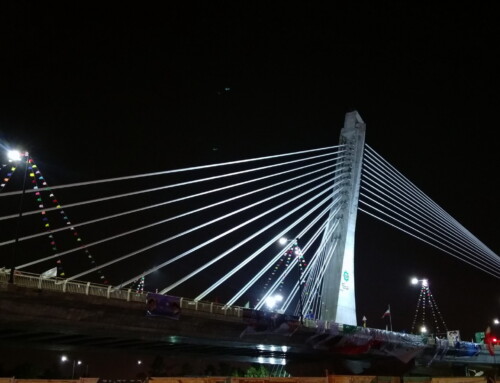
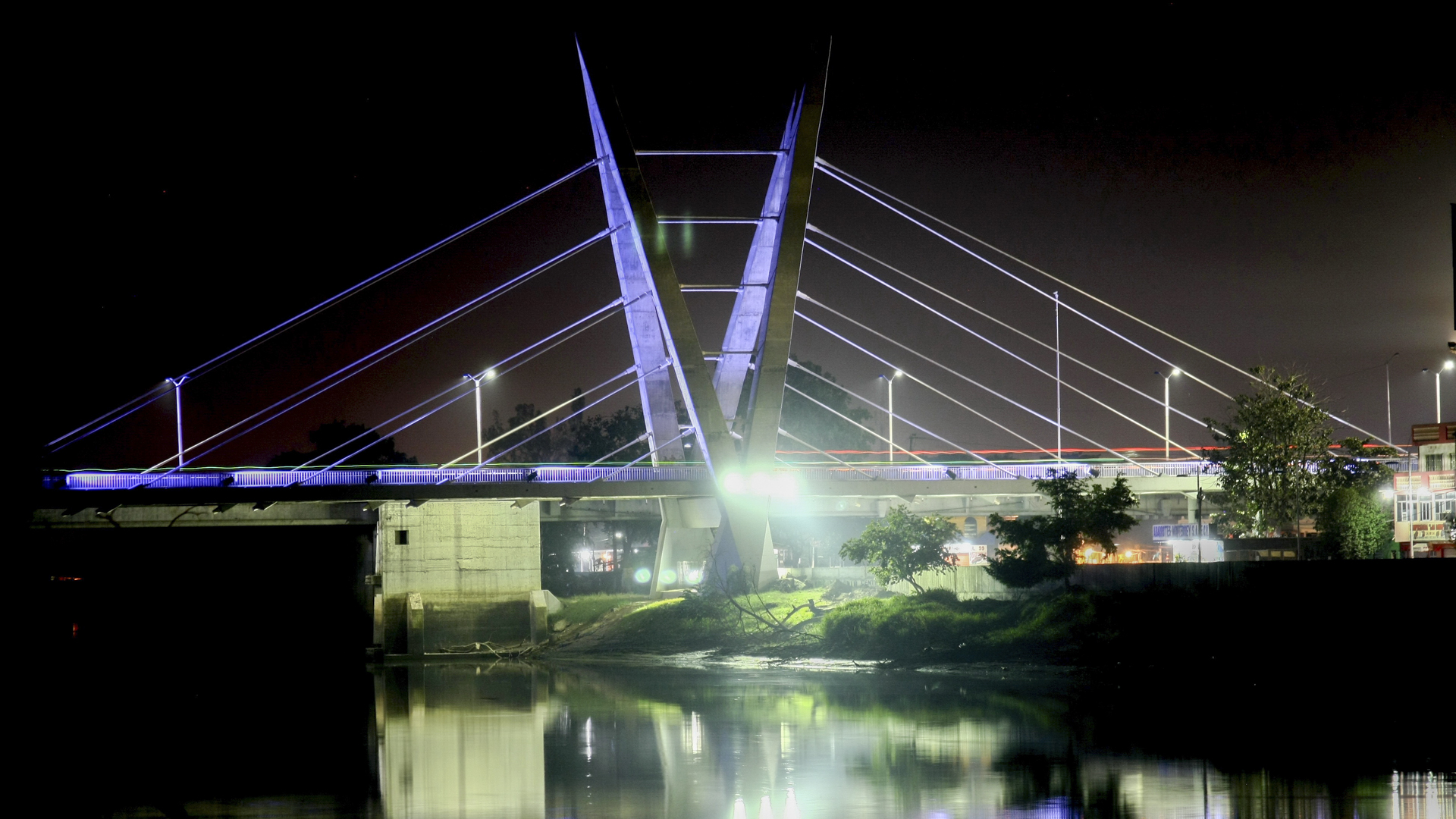
The relatively small span of this bridge between the cable-stayed bridges has led us to propose a unique solution, giving maximum prominence to the towers with a spatial configuration, because they open in V in the elevation of the bridge, and close in A in the transversal plane.
The shape of the V-shaped tower forces the tie rods to have three alignments, two inclined alignments connecting the arms of the V and the deck, and one horizontal alignment between the arms of the V. This has led us to study a system of chairs that allows the tie rods to be fixed to the towers for live loads, and also allows the tie rods to be replaced without altering the deck or the towers. This has been achieved by making the chairs with a double tube, an outer one attached to the tower and a free inner one, where the stay cables are housed. At the ends of the saddles, outside the tower, through anchors are provided to resist load variations in the stay cables caused by live loads. These anchorages are fixed to the tower by means of a thread that connects them to the fixed tube of the saddle.
The bridge has been built by successive cantilevers made in situ by means of a trolley, advancing symmetrically from each tower towards the center of the main span and towards the end piers. The anchorages of the stay cables in the deck are spaced 10 meters apart; this distance, and the 0.80 meter depth of the deck, made it necessary to temporarily brace all the segments, which are 3.30 meters long. Therefore, between each two definitive tie rods there are two provisional tie rods, which are removed when the next definitive tie rod is tensioned.