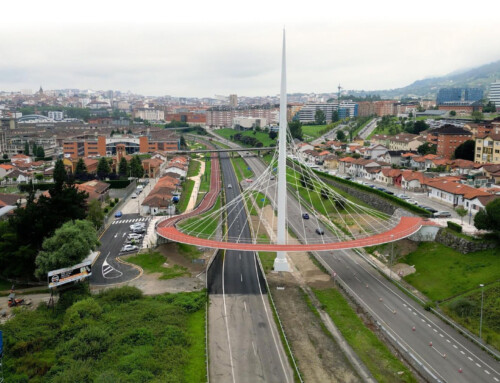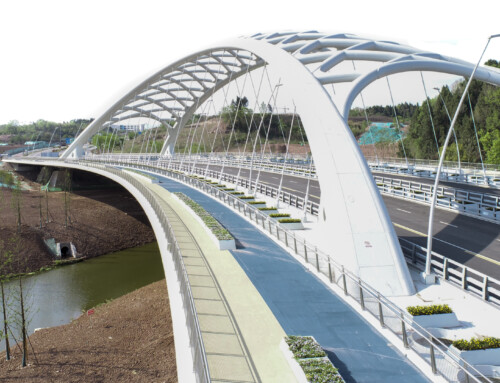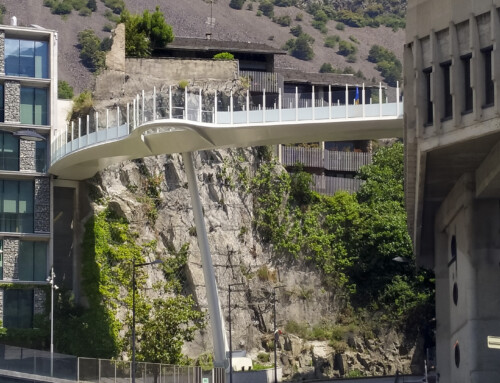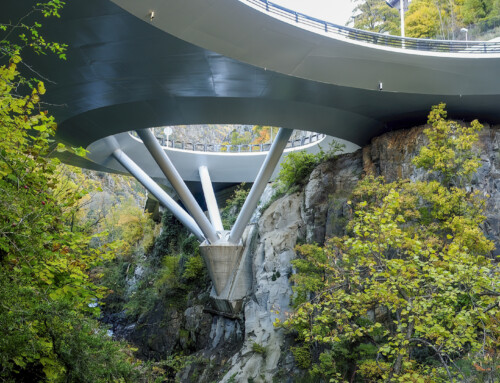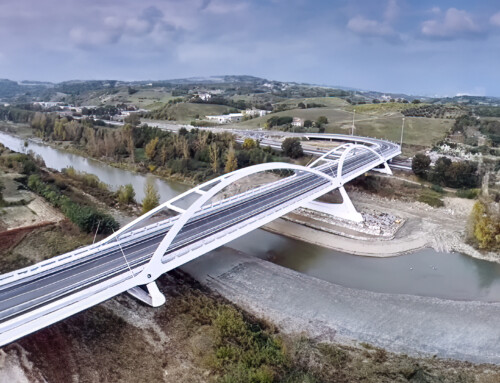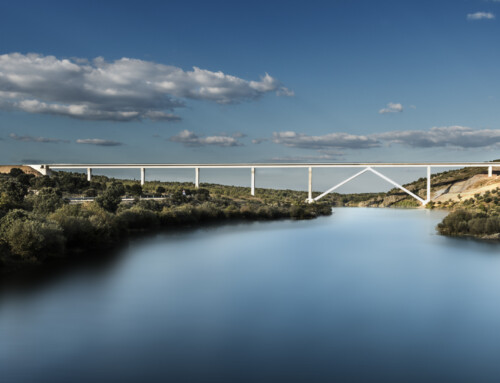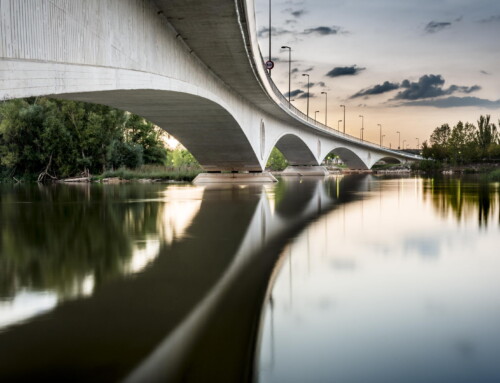


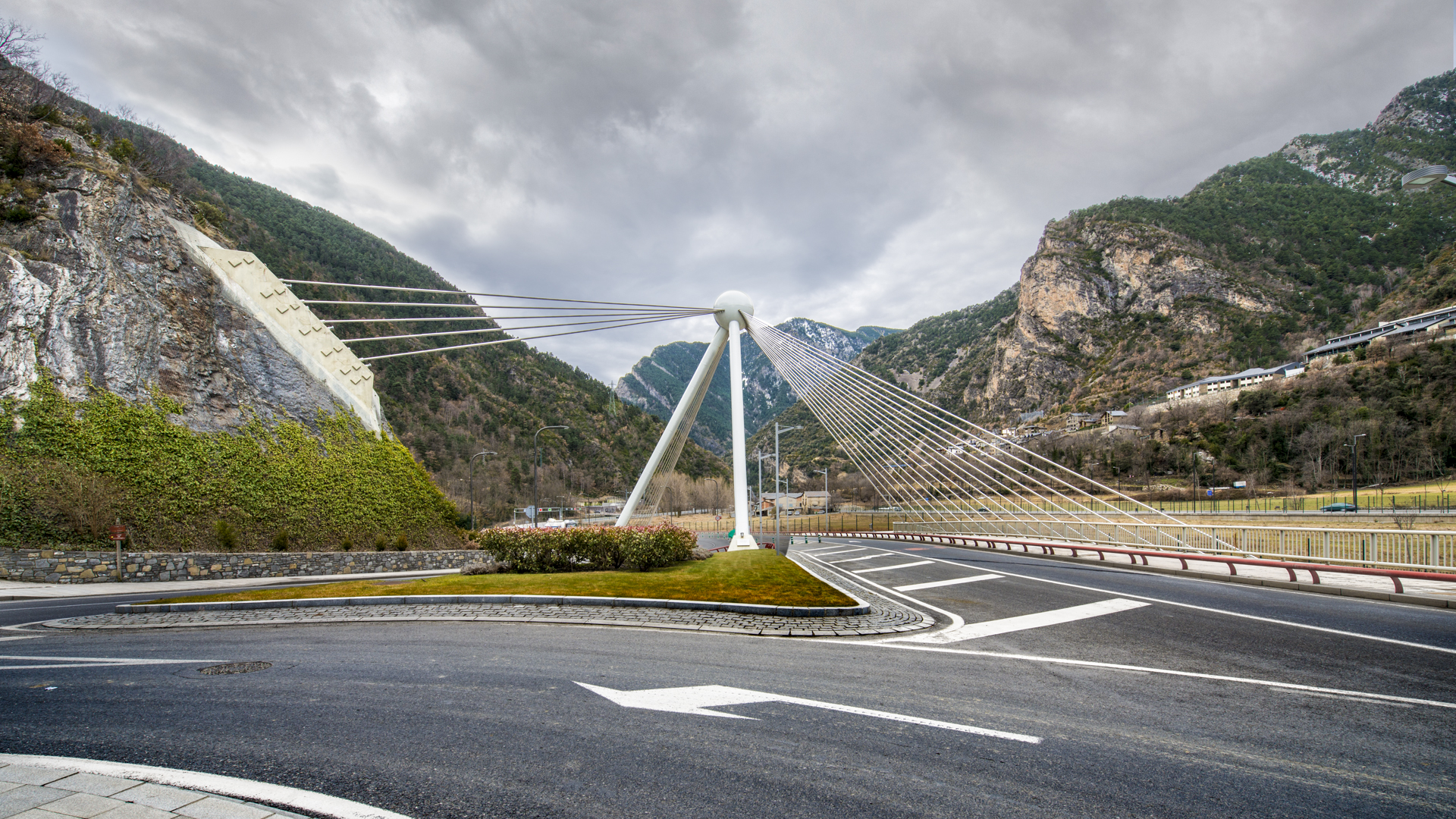
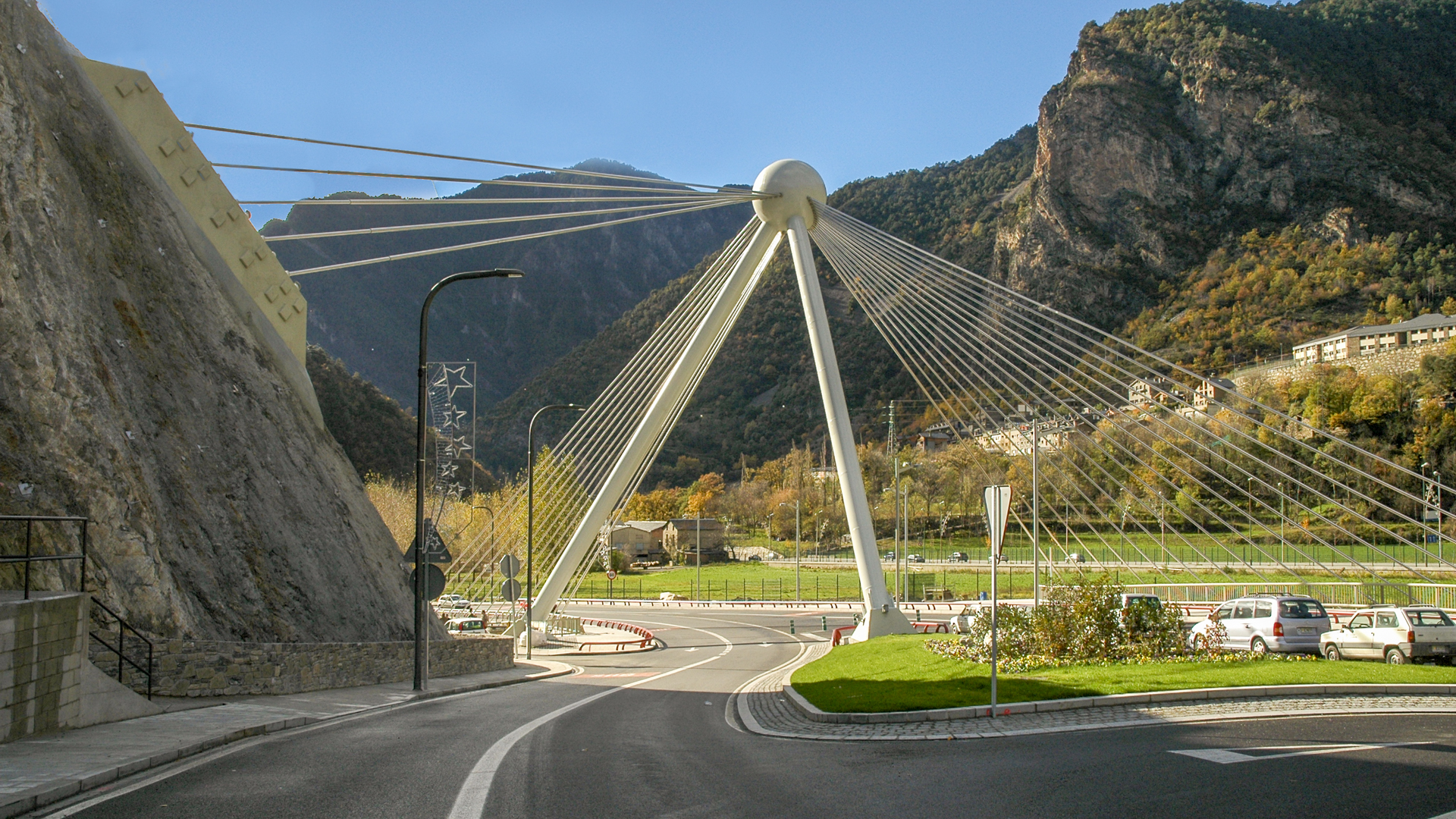
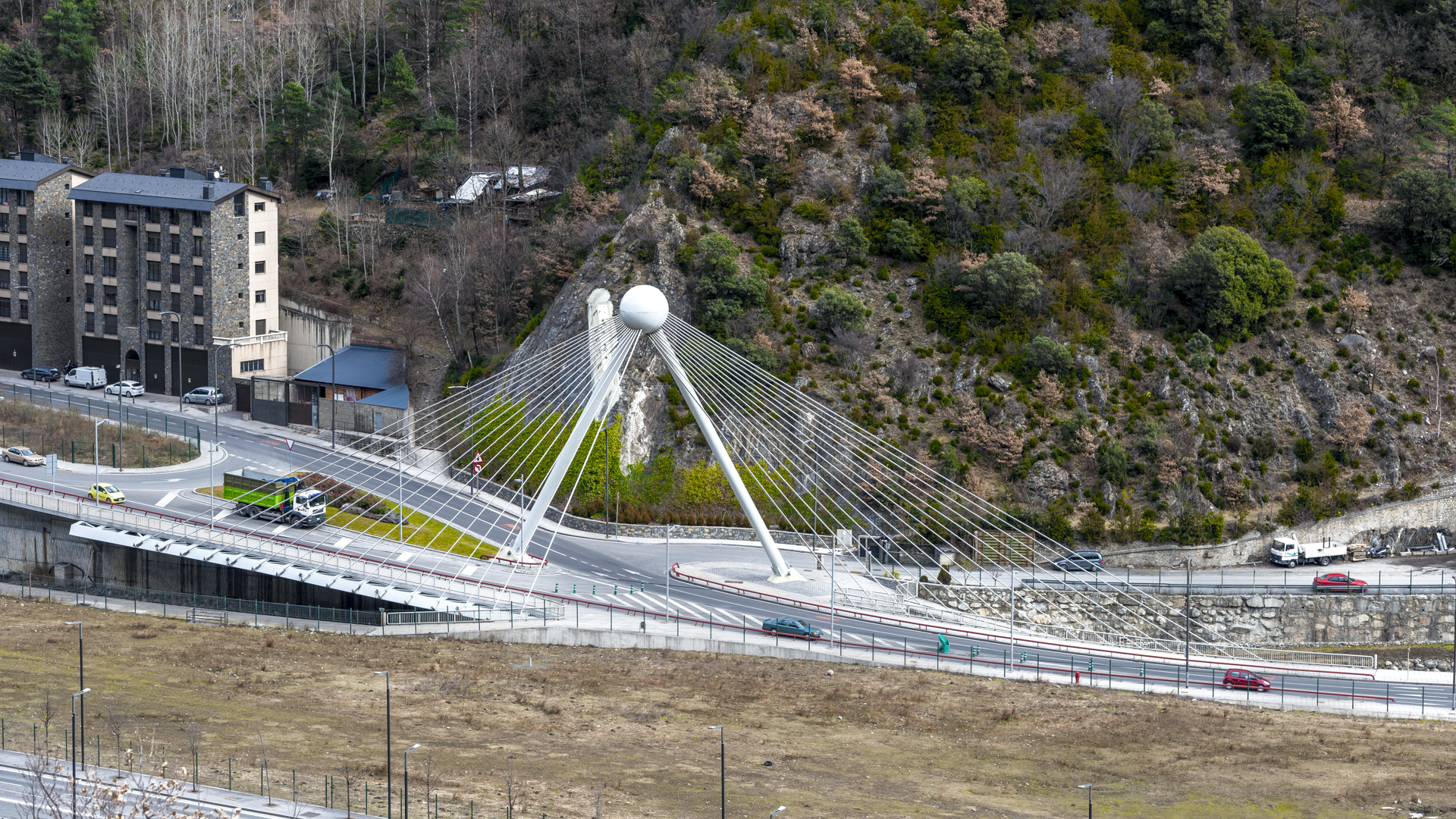
Madrid Bridge over the Valira River in the Santa Coloma-La Margineda section. Andorra. 2006.
Bridge over the Valira River in the Santa Coloma-La Margineda section. Andorra. 2006.
The Madrid bridge is located on a new access from the south to the town of Andorra la Vella.
The Gran Valira river valley is the southern access to the country, coming from Spain, which induces an important traffic. For this reason, in the section close to the town of Andorra la Vella, the access that goes up the right bank has been widened, with an additional access on the left bank that reaches the town. This new access requires a bridge to pass from one bank to the other at the beginning of the widening.
DESCRIPTION OF THE BRIDGE
LINKS
The bridge is supported on the canal edge walls, which are also founded on the haulage. One wall was already built and the other was new with a similar solution, and the foundations of both were reinforced with micropiles.
BOARD
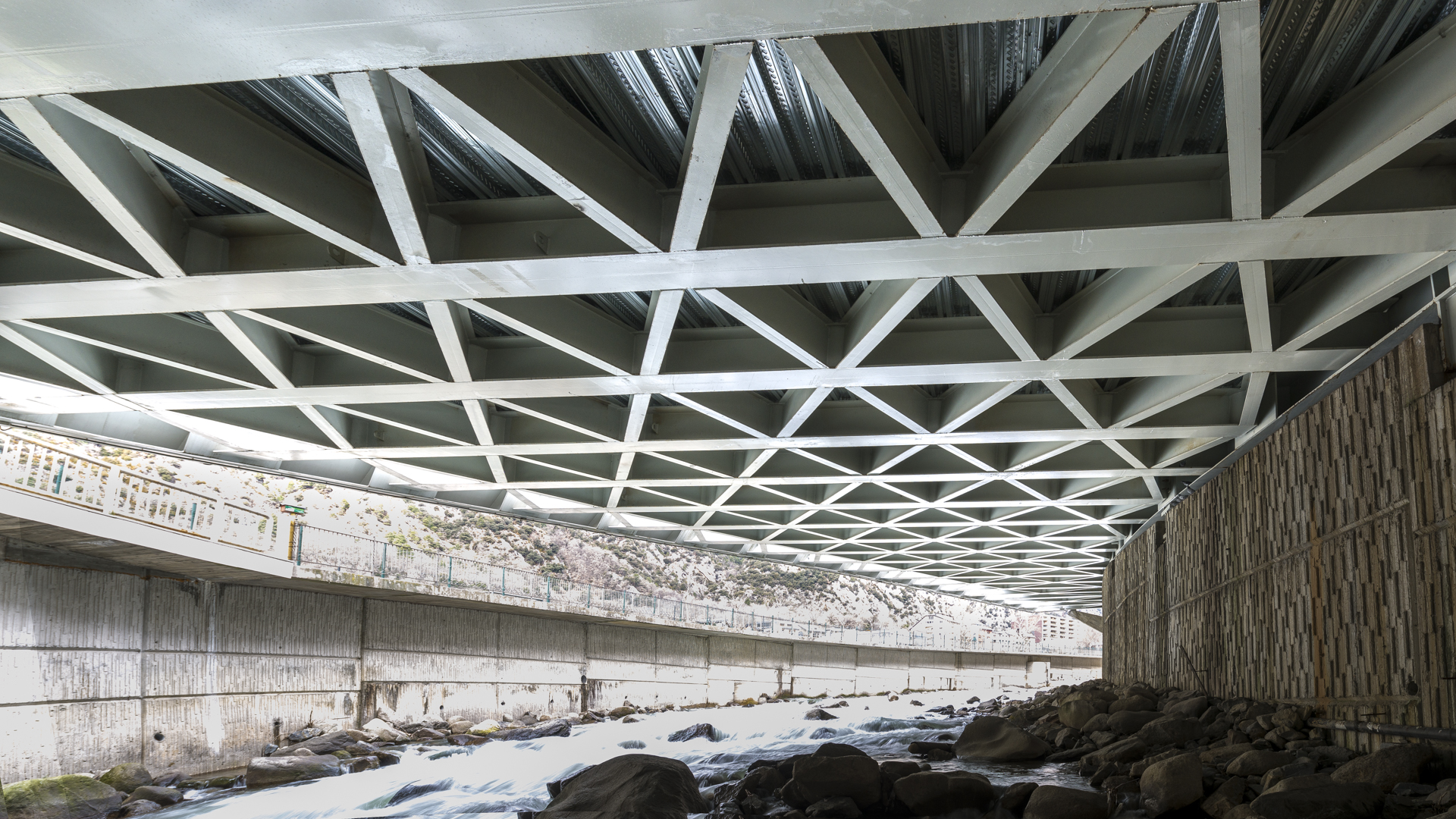
The board is formed by an irregular surface with four curved edges, which form a figure similar to a rhombus.
At the triangulation nodes, three beams are joined, the main beam and two secondary beams that reach it. This was solved in the project by means of two solid half cylinders welded to the two sides of the web of the main beam passing through the node. The webs of the secondary beams were welded to these cylinders.
The edge beams to which the tie rods are anchored are formed by C-beams of irregular section, because the web is inclined to coincide as much as possible with the inclination of the tie rods. These beams are joined to the rest of the structure by welding the webs of the grillage beams to their webs.
The tie rods are anchored by means of tubes connected with a plate to the edge beam. The tie rods are passed through the tube and anchored with a plate and nut at the lower end.
UPPER STRUCTURE
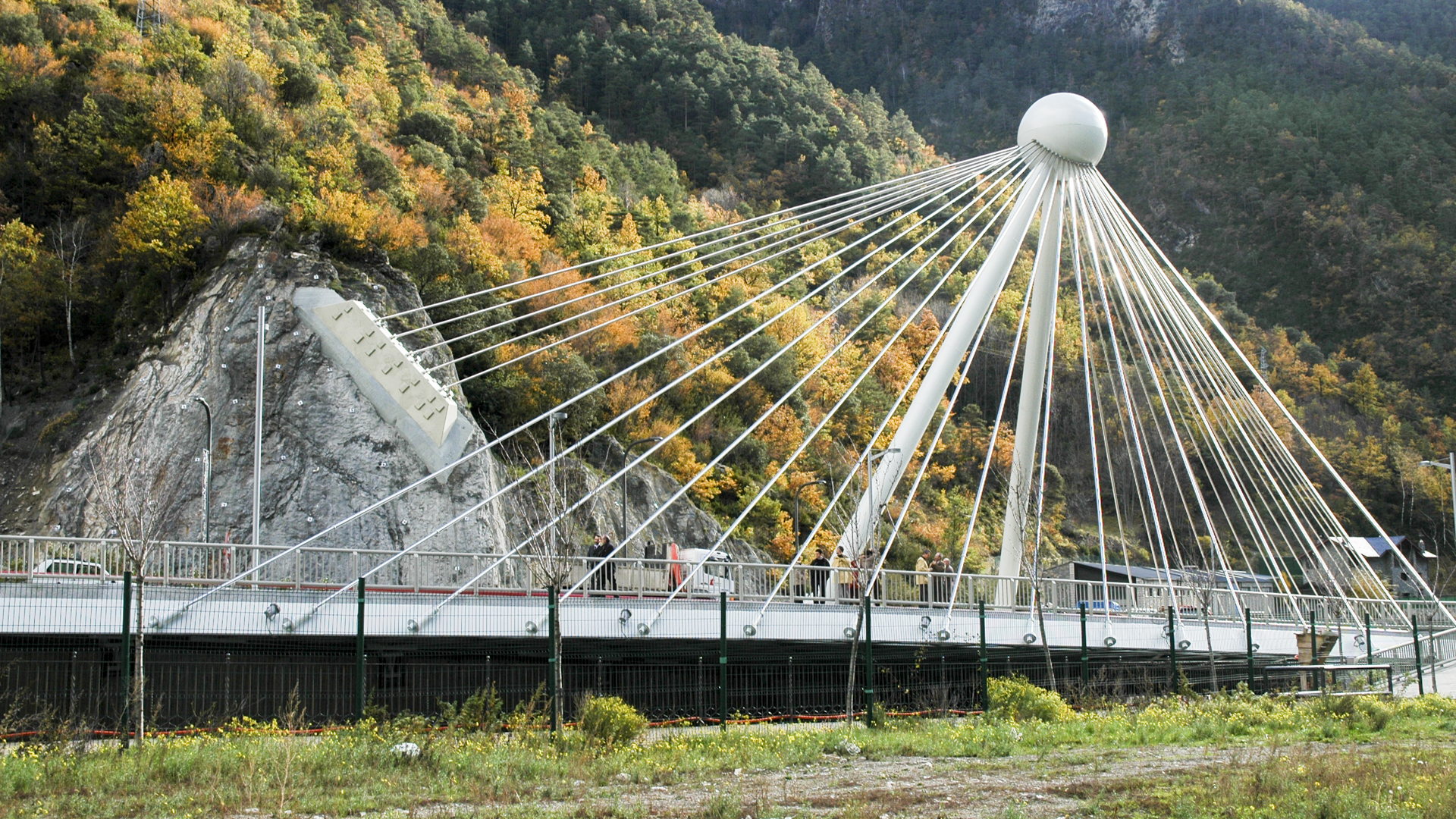
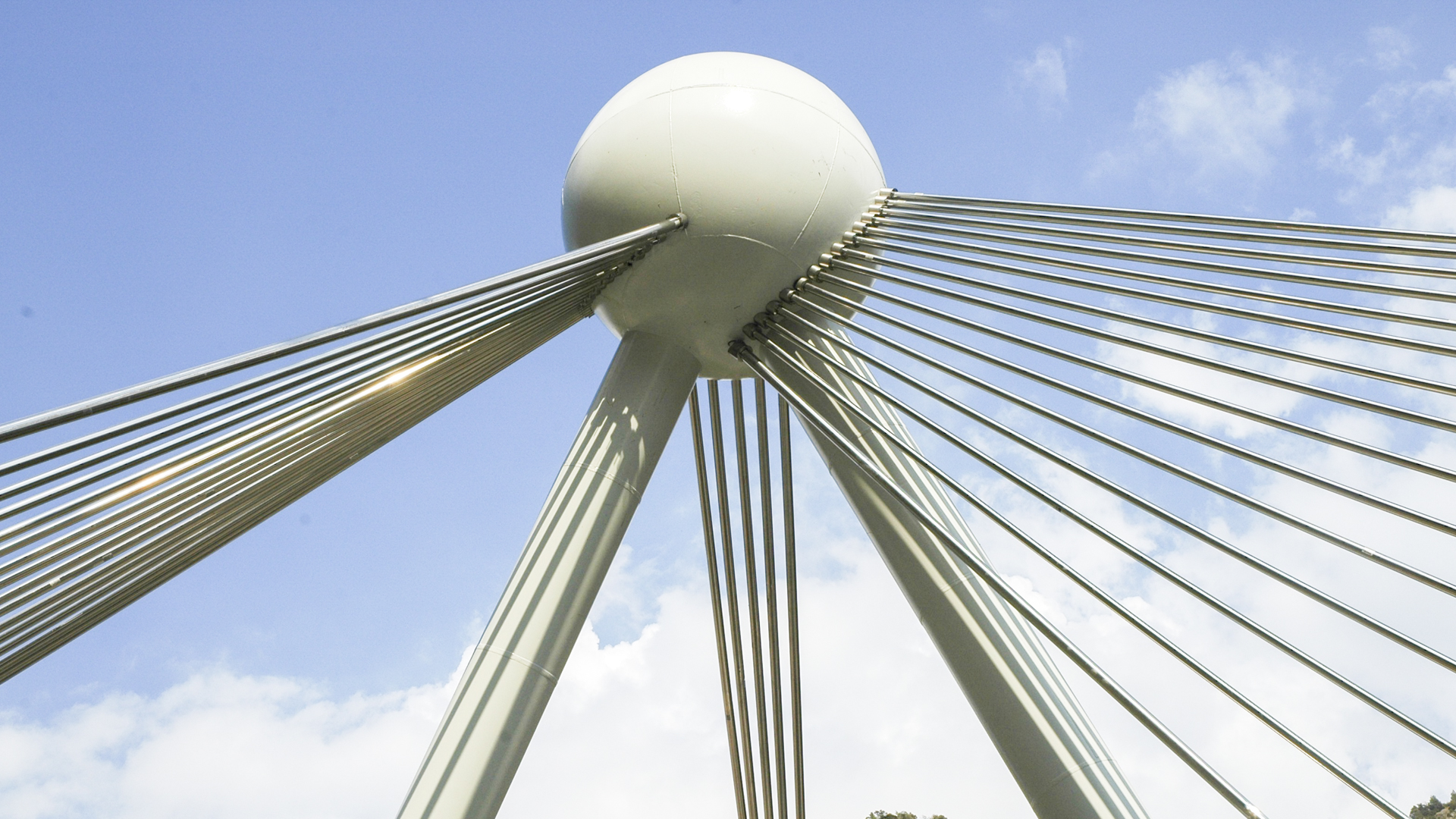
The upper structure is formed by a 4 m. diameter sphere where the tie rods that support the deck and the compensation tie rods, which are anchored at the other end to the rock, are anchored.
The sphere is supported on a bipod formed by two one-meter diameter tubes. Each tie rod is formed by a 50 mm or 75 mm diameter bar, depending on the load to be resisted, and those joining the sphere to the rock are of 75 mm. These tie rods have double protection: a plastic sheath attached to the bar and an outer stainless steel sheath.
Each tube of the bipod is supported on a triangular section massif to which the support tubes are anchored. These massifs are founded by means of inclined micropiles.
GROUND ANCHORAGES OF THE SPHERE FASTENING SUSPENDERS
The structure’s compensation stays are formed by bars anchored at one end in the sphere, and at the other end in the rock slope adjacent to the bridge, on the left bank of the river.
The anchoring to the rock was carried out by means of a concrete massif attached to the rock, from which the five tie rods that hold the sphere, which are formed by Ø 75 mm. steel 85/105 bars, depart. This massif was fixed to the rock by means of 12 prestressed anchors.
CONSTRUCTION PROCESS
1- Assembly of the metal structure of the board.
2- Assembly of the upper structure.
3- Tightening of the tie rods.
4- Concreting of the slab.
5- Paving and finishing.